
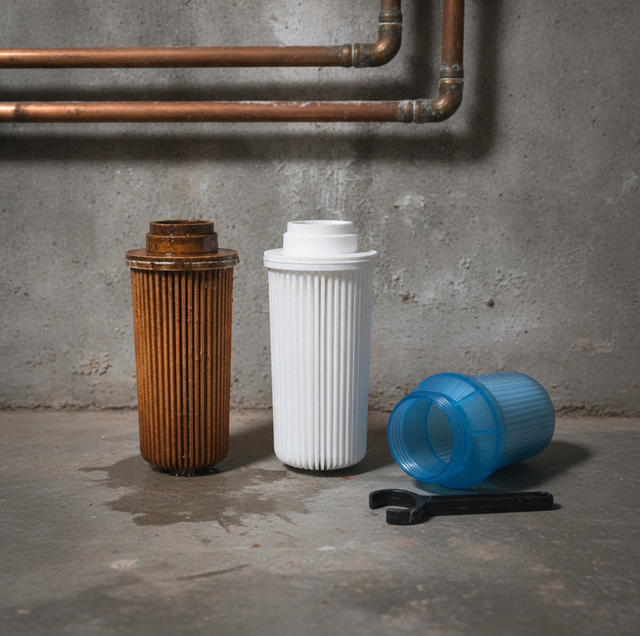
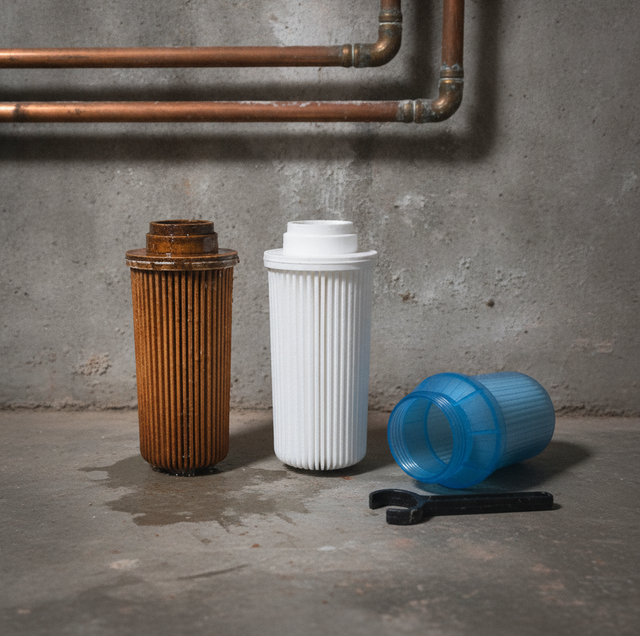
Two homeowners can stand in the same aisle looking at "water treatment" equipment and walk out needing completely different machines. One has crusty white buildup on the showerhead and a water heater that clanks. The other has water that smells faintly of a swimming pool and leaves grit in the aerator. A softener fixes the first. A filter fixes the second. Buy the wrong one, and the original complaint never goes away.
The confusion is understandable, because both units are big tanks that plum into the main line, and both get called "water systems" in casual conversation. But they treat different things, work by different chemistry, and are maintained on different schedules. Here is what each one actually does.
What a Water Softener Actually Does
Hard water is water carrying dissolved minerals, mainly calcium and magnesium. Those minerals are invisible in the glass, but when the water is heated or left to evaporate, they drop out of solution and cling to whatever surface is handy: the inside of a pipe, the walls of a water heater tank, the face of a faucet, the glass of a shower door. That deposit is scale, and it is the source of most hard-water complaints.
A softener removes those minerals through a process called ion exchange. The tank is full of small resin beads that carry a light electrical charge. As hard water passes through, the calcium and magnesium ions stick to the beads, and the beads release sodium (or potassium) ions in their place. The water that leaves the tank has traded its scale-forming minerals for ones that stay dissolved. That is why soap suddenly lathers, why the shower door stops filming over, and why a water heater lasts longer rather than insulating itself with a mineral crust.
Here is the part people miss: a softener is a hardness machine and nothing else. It does not remove chlorine. It does not fix a bad taste or a musty odor. It does not catch sediment or rust. It will not touch most contaminants. Send funny-tasting water through a softener, and you get funny-tasting soft water. The chemistry it runs simply is not aimed at those problems.
What a Whole-House Filter Actually Does
A whole-house filter is built around a different goal: water quality rather than hardness. Most systems stack a few stages, each targeting a specific nuisance.
A sediment stage comes first: a physical screen or graded-density cartridge that catches grit, sand, and rust flakes before they reach the rest of the plumbing. A carbon stage follows, where the water passes through activated carbon that adsorbs chlorine and the compounds behind chlorine taste, chemical smell, and general off-flavors. From there, homes with specific problems add specialty media: a manganese-oxide or air-injection stage for iron, a catalytic carbon or oxidizing bed for the sulfur that produces a rotten-egg odor.
Think of the filter as a series of nets with progressively finer mesh, each pulling a different thing out of the stream. The catch, again, is what those nets are not sized to grab. Calcium and magnesium stay dissolved in the water and slip straight through every stage. A filter can make your water clear, clean-smelling, and pleasant to drink, while still leaving every bit of scale-forming hardness intact. Fixtures will keep crusting over because the filter was never built to touch the mineral that causes it.
Softener vs Filter at a Glance
| Water Softener | Whole-House Filter | |
|---|---|---|
| Removes | Calcium and magnesium (hardness) | Sediment, chlorine, taste, odor; iron/sulfur with the right media |
| Method | Ion exchange (swaps minerals for sodium/potassium) | Physical screening plus carbon and specialty media |
| Stops scale? | Yes | No |
| Improves taste and clarity? | No | Yes |
| Maintenance | Salt refills, periodic regeneration | Cartridge or media replacement on a schedule |
The table makes the split obvious: the two products barely overlap. One column is about protecting your plumbing from mineral buildup; the other is about what the water looks, smells, and tastes like coming out of the tap.
The Salt-Free "Conditioner" Middle Ground
There is a third category that adds to the confusion: the salt-free water conditioner. These are often marketed alongside softeners and sometimes called "salt-free softeners," which is misleading, because they do not soften water in the technical sense.
Instead of removing calcium and magnesium, a conditioner runs the water across a specially prepared media that uses template-assisted crystallization. The minerals are still there, but the process nudges them into tiny stable crystals that tend not to bond to surfaces. In practice, that means less scale forming on your pipes and water heater, without any salt going into the water and without a regeneration cycle. Manufacturers report significant scale reduction with this approach; independent of any single brand's numbers, the useful way to frame it is that a conditioner changes the form of hardness rather than eliminating it. The water is not "soft," soap will not lather the way it does after true softening, and a hardness test will still read high. For a household that mainly wants to protect appliances and skip the salt, that trade can be reasonable. For one who wants that classic soft-water feel, it is not the same tool.
When You Need Both
Plenty of homes have hard water and chlorinated or otherwise imperfect water at the same time. Many regions are a good example: where the supply is quite hard, often well up the scale, scale control is a real concern rather than a hypothetical one. That same water is typically chlorinated for delivery, so it can also carry the taste and smell a filter is meant to reduce. Hardness is a year-round property of the supply, not a seasonal one, and the chlorine taste that bothers people in the summer heat is present in January as well, so neither problem is something you can treat once and forget.
When both problems are present, the two units work as a team rather than competing. A common arrangement puts the whole-house filter first so it can remove chlorine and sediment from the water, then the softener. Some manufacturers build combined cabinets that house both functions in one footprint. Either way, the point stands: a filter cannot do a softener's job, and a softener cannot do a filter's job, so a home with both problems truly needs both solutions.
How Maintenance Differs
These systems also ask different things of you over time, and that difference is worth weighing before you buy.
A softener runs on salt. You keep a brine tank topped up with salt (or potassium chloride) pellets, and on a set schedule, the unit regenerates: it flushes the accumulated hardness off the resin beads and recharges them, using both salt and a fair amount of water in the process. Forget to refill the salt, and the resin eventually stops exchanging, and hard water sails right through.
A filter runs on replacement. There is no salt and usually no regeneration; instead, each stage has a service life. Sediment and carbon cartridges load up and need swapping on a schedule, and specialty media beds get rebedded or replaced when they are exhausted. Skip those changes, and a clogged or spent filter can restrict flow or simply stop removing what it used to.
Neither is difficult, but they are different commitments: one is a standing salt-and-water routine, the other is a periodic parts change.
How to Decide
The honest answer to "which one do I need" starts with a water test rather than a sales pitch. A test reports two separate things, and each points to a different piece of equipment.
The first is the hardness number, a measurement of how much calcium and magnesium the water carries. A high number of points straight at a softener, because that is the only unit here that removes those minerals. The second is everything else in the report: chlorine, sediment, iron, a sulfur odor, and an off taste. Those points at filtration. If the test comes back with a high hardness number, a chlorine taste, and a trace of iron, that is not a tie to break; it is a clear case for both. Match the equipment to what the water actually contains, and the original complaint is the one that goes away.
Installation for any of these is real plumbing work. Each unit ties into the main line, needs a bypass for service, and (in the softener's case) a drain connection for regeneration, so this is a job for a licensed plumber rather than a weekend guess. Getting the sizing and order right the first time is what keeps the system working as the water test said it should.
FAQs
If I have a filter, do I still need a softener?
If your water is hard, yes. A sediment and carbon filter is designed to remove particulates and strip the chlorine taste and smell, but it does nothing to remove the dissolved calcium and magnesium that actually scale your pipes. Only ion exchange (a salt softener) or a template-assisted crystallization conditioner does anything about that hardness; a carbon-and-sediment filter has no mechanism to address it. So the minerals slip straight through and keep the fixtures and the water heater from crusting, which is why hard-water homes run a filter and a softener together rather than choosing one.
What order should a softener and filter go in?
Commonly, the whole-house filter is plumbed first to strip out chlorine and sediment that would otherwise foul the softener's resin bed over time, with the softener plumbed second. It is not an ironclad rule, though; the right order depends on the specific equipment and the water test results, so the sequence is set on a case-by-case basis rather than by a single default.
Does a softener add salt to my drinking water?
It adds a small amount of sodium in exchange for the hardness minerals it removes, or potassium if the unit is loaded with potassium chloride instead. The amount is modest, but it is why some households add a separate reverse-osmosis tap at the kitchen sink for drinking and cooking water, so they get the benefits of softening everywhere else without the added sodium in the glass.
What is a salt-free conditioner, and how is it different?
A salt-free conditioner uses template-assisted crystallization: its media seeds the dissolved calcium and magnesium into microscopic crystals that stay suspended in the water and no longer stick to pipe walls or heating elements. So it reduces scale without removing any minerals, which is the opposite of a salt softener, which strips hardness out via ion exchange. Practically, that means no drain line, no salt, and no electricity, and a hardness test still reads high afterward. The trade-offs: it wants relatively clean feed water, so it is usually paired with a sediment and carbon pre-filter ahead of it, and because the minerals are still present, the water will not lather or feel slick the way truly softened water does.
How do the maintenance needs differ?
A softener needs its brine tank refilled with salt and regenerates on a cycle that consumes water to recharge the resin. A filter has no salt tank; instead, its cartridges or media reach the end of their service life and get replaced on a schedule. So one system is an ongoing salt-and-water routine, and the other is a periodic parts swap, which is worth factoring in alongside each unit's removal.
How do I know which one I actually need?
Start with the hardness number, which is reported in grains per gallon (gpg) on either a simple test strip or a lab panel. Water running above roughly 7 gpg is generally considered hard enough to warrant a softener, and the higher the reading climbs above that, the stronger the case. The same report will flag chlorine, sediment, iron, or a sulfur odor, which point to filtration; a high gpg reading alongside those quality issues means both units, not a choice between them.