
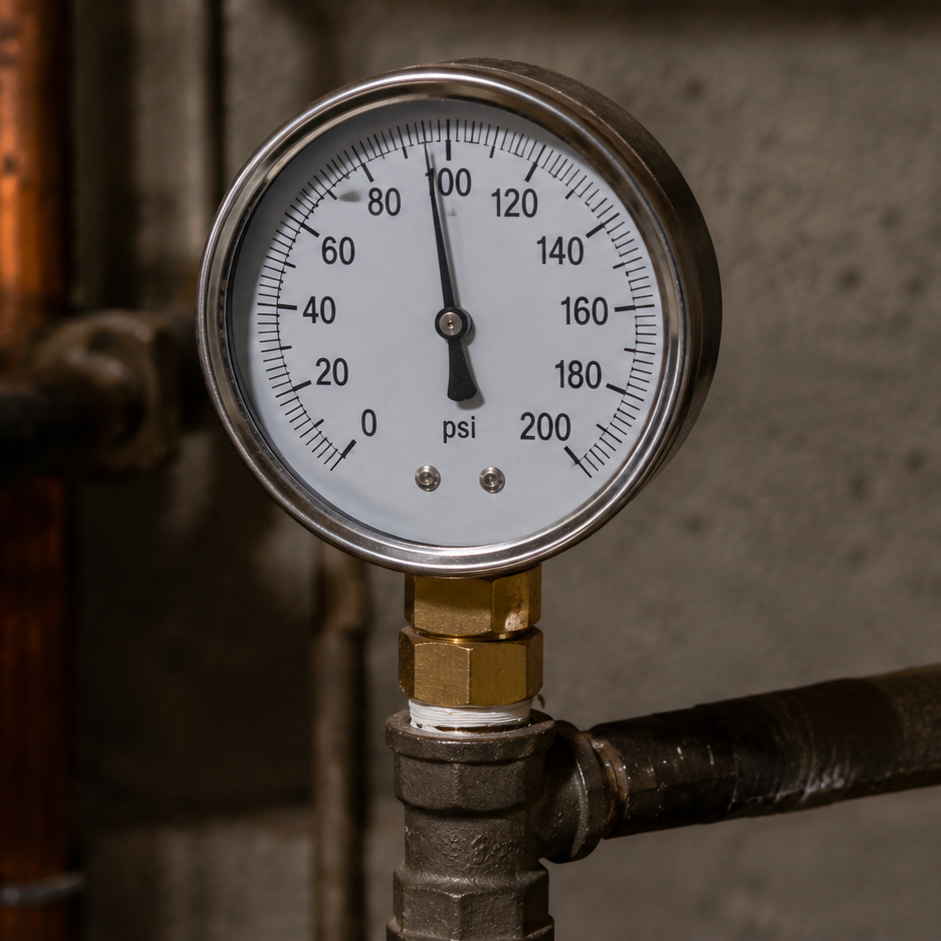
High water pressure feels great in the shower, which is exactly why it sneaks up on people. But the same force that gives you a strong spray is hammering away at every pipe, joint, valve, and appliance in the house, around the clock. Over time, that steady strain causes leaks and failures that look unrelated until you realize they share one cause. Here's how to recognize when your pressure has crossed from strong into damaging.
What Counts as Too High
Most homes are comfortable and safe at 40-60 psi. Plumbing code draws a hard line at 80 psi: once static pressure exceeds that, a pressure-reducing valve is required because above it the risk of damage rises quickly. So if your pressure is sitting at or above 80, it's not a luxury — it's working against your plumbing. The tricky part is that high pressure rarely announces itself directly; it shows up as a collection of seemingly separate problems.
The Warning Signs
Banging or Hammering Pipes
If you hear a bang, thud, or hammering sound when you shut off a faucet or when an appliance valve closes, that's often water hammer, and high pressure makes it much worse. Fast-moving water under high pressure slams to a stop and shocks the pipes. Beyond the noise, that repeated shock loosens joints and stresses connections over time.
Faucets That Blast and Splash
Water that comes out hard enough to splash out of the sink, or a shower that feels punishingly strong, is a simple, everyday clue. Strong flow is nice; flow that sprays everywhere and makes the pipes shudder is a sign that the pressure is past where it should be.
Running or Leaking Toilets
A toilet that randomly runs, hisses, or refills on its own can be reacting to pressure that's forcing water past the fill valve and flapper. High pressure wears those seals out faster and pushes water through gaps that would hold at normal pressure.
Dripping Faucets and Recurring Leaks
If you keep replacing washers and fixing drips only to have them come back, the pressure may be the real culprit. Constant high pressure pushes water past seals and worn parts, so leaks return no matter how many times you fix the symptom.
A Water Heater That Fails Early
The water heater takes a real beating from high pressure. If the temperature-and-pressure relief valve on it keeps weeping or discharging, or the tank fails years before it should, excess pressure is a prime suspect. A heater is expensive to replace early, which makes this a costly sign to ignore.
| Sign | What it points to |
|---|---|
| Banging pipes when valves close | Water hammer worsened by high pressure |
| Faucets blast and splash | Pressure above comfortable range |
| Toilets run or hiss on their own | Pressure forcing past worn seals |
| Drips and leaks that keep returning | Pressure pushing past fixtures |
| Relief valve on water heater weeping | Excess pressure stressing the tank |
Why It Matters
None of these is just an annoyance. Every fixture, supply line, and appliance valve in your home is rated for a pressure range, and operating above that range shortens the life of all of them at once. The damage is cumulative and quiet — a faucet here, a toilet there, a water heater that "just wore out" — until the bigger failure arrives: a burst supply line or a flooded room. Bringing the pressure down protects the entire system at once, which is why it's one of the highest-value fixes in a house.
How to Check It Yourself
You don't have to guess. A water pressure gauge that screws onto a hose bib costs only a few dollars at any hardware store. Thread it onto an outside spigot (or the laundry connection), make sure no other water is running, and open the valve fully. The needle shows your static pressure. If it reads in the 40-60 range, you're fine. If it's pushing 80 or beyond, that's confirmation that the pressure is too high, and your plumbing has been paying for it.
One thing worth knowing: pressure can also spike at night or change over time as the municipal supply varies, so a single low reading during the day doesn't always rule it out. A gauge that captures the peak, or a quick check by a plumber, gives a fuller picture.
The Fix
The standard solution is a pressure-reducing valve (PRV) installed on the main line where water enters the house. It takes the high incoming pressure from the street and steps it down to a safe, steady level for the whole home. Many houses already have one, and a worn-out PRV that's no longer regulating is itself a common reason pressure creeps back up. Installing or replacing a PRV ties into the main water line and needs to be sized and set correctly, so it's work for a plumber rather than a weekend project, but it's a routine fix that protects everything downstream of it.
FAQs
What is normal home water pressure?
Most homes run between 40 and 60 psi comfortably. Plumbing code requires a pressure-reducing valve once static pressure tops 80 psi, because above that, the strain on pipes, fixtures, and appliances becomes a real risk. If your pressure is near or above 80, it's high enough to cause wear, even if the house seems fine day-to-day.
How do I know if my water pressure is too high?
Watch for banging pipes when valves close, faucets that blast and splash, toilets that run on their own, drips and leaks that keep returning, and a water heater relief valve that weeps. The sure way to know is to test it: a hose-bib pressure gauge costs a few dollars, and a reading of 80 psi or higher confirms it's too high.
Can high water pressure damage my pipes?
Yes. High pressure continuously stresses every joint, seal, valve, and appliance, accelerating leaks, worsening water hammer, wearing out fixtures, and shortening the life of your water heater. The damage is gradual and easy to mistake for unrelated problems — until a supply line bursts. Reducing the pressure protects the whole system at once.
Why does my water heater's relief valve keep leaking?
A temperature-and-pressure relief valve that weeps is often reacting to excess pressure in the system. As pressure climbs, the valve does its job and discharges — but if it keeps doing so, the underlying pressure needs to be addressed, not just the valve. High pressure also shortens the tank's life, so it's worth checking your pressure if the relief valve won't stop dripping.
What is a pressure-reducing valve?
A pressure-reducing valve (PRV) is installed on your main water line and steps the high pressure coming from the street down to a safe, steady level for the house. It's the standard fix for high water pressure. Many homes have one already, and a failed PRV is a common reason pressure rises again, so replacing a worn one often solves a creeping-pressure problem.
Strong Shower, Tired Pipes
High water pressure is a quiet, system-wide stress that disguises itself as a string of small, separate problems — banging pipes, running toilets, leaks that won't stay fixed, a water heater gone too soon. Test it with a cheap gauge, and if it's near or past 80 psi, a pressure-reducing valve brings the whole house back into a safe range. It's one repair that quietly protects every pipe and appliance you own.