
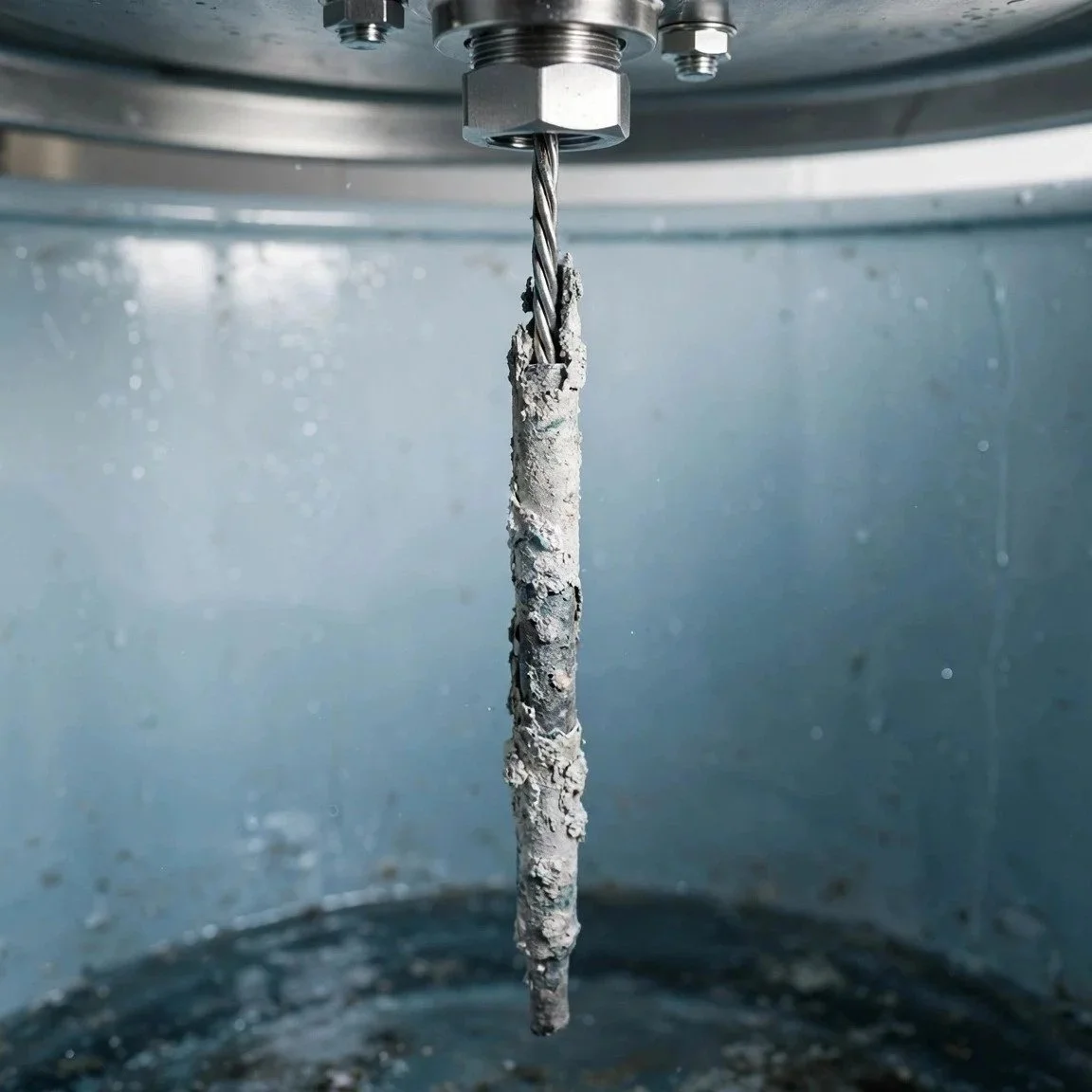
What an Anode Rod Actually Does
Inside every tank-style water heater is a long metal rod, usually running from the top of the tank almost to the bottom. It is called a sacrificial anode, and the word "sacrificial" is the whole point. The rod is built to be eaten away by corrosion so that the steel tank around it is not.
That protection comes from a process called galvanic corrosion, and it is worth understanding before anything else in this article makes sense. When two different metals sit in the same water, the more chemically reactive one corrodes first. It gives up its metal to the water while the less reactive metal is spared. Engineers put this to work on purpose: they place a highly reactive metal (the anode rod) inside the tank so the water attacks it instead of the steel walls and the glass lining's tiny flaws. The rod loses; the tank wins.
Inside every tank-style water heater is a long metal rod, usually running from the top of the tank almost to the bottom. It is called a sacrificial anode, and the word "sacrificial" is the whole point. The rod is built to be eaten away by corrosion so that the steel tank around it is not.
That protection comes from a process called galvanic corrosion, and it is worth understanding before anything else in this article makes sense. When two different metals sit in the same water, the more chemically reactive one corrodes first. It gives up its metal to the water while the less reactive metal is spared. Engineers put this to work on purpose: they place a highly reactive metal (the anode rod) inside the tank so the water attacks it instead of the steel walls and the glass lining's tiny flaws. The rod loses; the tank wins.
How Galvanic Protection Works Inside the Tank
Every steel water heater tank is coated on the inside with a thin layer of glass, sometimes called a glass lining or porcelain enamel. That coating is the first line of defense, but it is never perfect. It has microscopic cracks, pinholes, and gaps around fittings where bare steel is exposed to water.
Without a rod, those exposed spots would corrode quickly, because hot water accelerates almost every kind of rust. The anode rod changes the chemistry of the whole tank. Because the rod's metal is more reactive than steel, the water's corrosive energy is drawn to the rod first. The exposed steel at those pinholes is left alone while there is anode metal to consume.
This is the same principle used to protect ship hulls, buried pipelines, and offshore platforms, where blocks of reactive metal are bolted on and swapped out on a schedule. A water heater is a small sealed version of that idea, with one replaceable rod doing the same job.
The Types of Anode Rod and When Each Is Used
Rods are built around a steel core wire with a chosen metal formed around it. The metal is what determines how the rod behaves and which water it suits best.
Magnesium: Magnesium is the most reactive of the common rod metals, which makes it the most protective. It gives up its metal readily, so it guards the tank aggressively. Magnesium is the usual choice for soft or moderately soft water and for anyone who wants the strongest protection. The trade-off is that a magnesium rod wears out faster in aggressive water, and it is the type most associated with a rotten-egg odor in some homes.
Aluminum: Aluminum rods are less reactive than magnesium, so they corrode more slowly and tend to last longer in harsh water. They hold up better where minerals are heavy and where a magnesium rod would be chewed through quickly. Aluminum is a common factory default in areas with demanding water chemistry.
Aluminum-Zinc: An aluminum-zinc rod is an aluminum rod with a small amount of zinc blended in. That zinc is added for one specific reason: it fights the rotten-egg sulfur smell that can develop in a water heater. If your hot water has started smelling like sulfur and a magnesium rod is the suspect, an aluminum-zinc rod is the standard swap.
Powered (Impressed-Current): A powered anode, also called an impressed-current anode, does not sacrifice itself at all. Instead of relying on a reactive metal, it plugs into an outlet and uses a small electrical current to protect the tank electronically. Because nothing is being consumed, it does not need periodic replacement the way a sacrificial rod does. Powered rods are often chosen for very hard water that devours ordinary rods, and for homeowners who would rather not replace a rod every few years.
Why a Softener Can Wear the Rod Out Faster
A water softener does its job by swapping hardness minerals for sodium. That makes the water gentler on fixtures and appliances, but softened water is also more electrically conductive and more aggressive toward a sacrificial anode. The softer, saltier water speeds up the galvanic reaction, so the rod gives up its metal faster than it would on unsoftened water.
The practical result is simple: a home with a softener often needs to check and replace the anode rod more often than a home without one. Softening is still good for the plumbing overall, but it shortens the rod's life, and a rod that dies unnoticed leaves the tank unprotected. If you run a softener, treat the rod as a more frequent maintenance item rather than a set-and-forget part.
The Rotten-Egg Smell Connection
If hot water in a home smells like rotten eggs while cold water does not, the anode rod is often involved. The odor comes from hydrogen sulfide gas, produced by sulfate-reducing bacteria that live harmlessly in some water supplies. Those bacteria feed on the sulfate in the water and, in the warm environment of a heater, react with a magnesium rod to release the sulfur smell.
Because the reaction depends on the highly reactive magnesium, switching to an aluminum-zinc rod usually calms it down. The zinc content and the lower reactivity together starve the reaction that makes the gas. This is why a plumber facing a rotten-egg complaint will often ask what rod is in the tank before doing anything else.
Why the Rod Needs Inspection Every Few Years
A sacrificial rod is being consumed the entire time the heater runs. Eventually it is reduced to a thin wire, or nothing but the bare steel core is left. At that point there is no more decoy, and the corrosion that was attacking the rod turns on the tank. From there, tank rust and eventual leaks are a matter of time.
What Inspection Involves: Checking a rod means finding it (it threads into the top of the tank, sometimes under a plastic cap, and on some models shares the hot-water outlet fitting), then unthreading it to see how much metal remains. The rod is long, so there needs to be enough clearance above the heater to pull it straight up, which is one reason a tight closet can complicate the job.
Doing It Safely, and When to Call a Pro
Replacing an anode rod is real work on an appliance full of scalding water, so the safety steps are not optional. Before touching the rod, turn off the heater: shut off the power at the breaker for an electric unit, or set the gas control to off for a gas unit and handle that control carefully. Close the cold-water supply valve, and relieve the tank's pressure and drain enough water before opening anything, because hot water under pressure can cause serious burns.
The rod fitting is often torqued down hard and can seize over years of heat and mineral buildup. A stuck rod, or a fitting that will not budge without risking damage to the tank, is a common point to stop and call a plumber rather than force it. There is also a bigger-picture judgment call: if a tank is very old and already near the end of its life, spending on a new rod may not be worth it, and replacing the heater can be the smarter move. A plumber can tell you which situation you are in before you invest labor in an aging tank.
Frequently Asked Questions
How long does an anode rod usually last before it needs replacing?
In average water, a sacrificial rod commonly lasts around three to five years, but that window swings widely. Very hard water, high water usage, or a softener can consume a rod in as little as a year or two, while gentle water and light use can stretch one past five years. Because the range is so wide, the reliable approach is to inspect the rod on a schedule rather than trust a fixed replacement date.
Can I check the anode rod myself without draining the whole tank?
You do not have to empty the tank completely, but you do need to relieve pressure and drain a few gallons so the water level drops below the rod's threaded fitting before you open it. You will also need a socket (commonly 1-1/16 inch) and often a breaker bar for extra force, plus headroom above the heater equal to the rod's length to pull it out. If the fitting will not loosen with reasonable force, stop before you twist the tank connection.
Will replacing the anode rod fix a water heater that already leaks?
No. Once a tank has rusted through and is leaking from the body, a new rod cannot repair the hole, and the heater needs replacement. The anode rod is preventive: it protects a sound tank from ever reaching that point. A new rod only pays off while the tank walls are still intact, which is exactly why the rod is a maintenance item and not a repair part.
Do tankless water heaters have anode rods?
Most traditional tankless heaters do not, because they hold very little water and do not store it hot for long periods, so there is no large steel tank to protect. A handful of hybrid and heat-pump-style tank units and some specialty models do use anodes, sometimes powered ones. If you have a storage tank of any kind, assume it has a rod worth checking; a purely on-demand tankless unit generally does not.
Is a rotten-egg smell from the water heater dangerous?
The hydrogen sulfide behind the smell is unpleasant and can taste and smell strongly at the low levels found in household hot water, but the odor itself is a nuisance rather than a health emergency at those concentrations. It does signal bacterial activity in the tank, so besides changing to an aluminum-zinc rod, flushing and sometimes disinfecting the tank is part of clearing it. Persistent odor from both hot and cold water points to a source in the supply, not the rod.
Does a powered anode rod really never need replacement?
The rod element of a powered anode is not sacrificed, so it can outlast several ordinary rods and is often treated as a long-term fixture. It is not entirely maintenance-free, though: it relies on electricity, so a tripped outlet, a failed unit, or an unplugged cord leaves the tank unprotected without any obvious sign. Powered rods should be verified as still powered and working during routine service, even though they are not swapped out on the same cycle as sacrificial rods.