
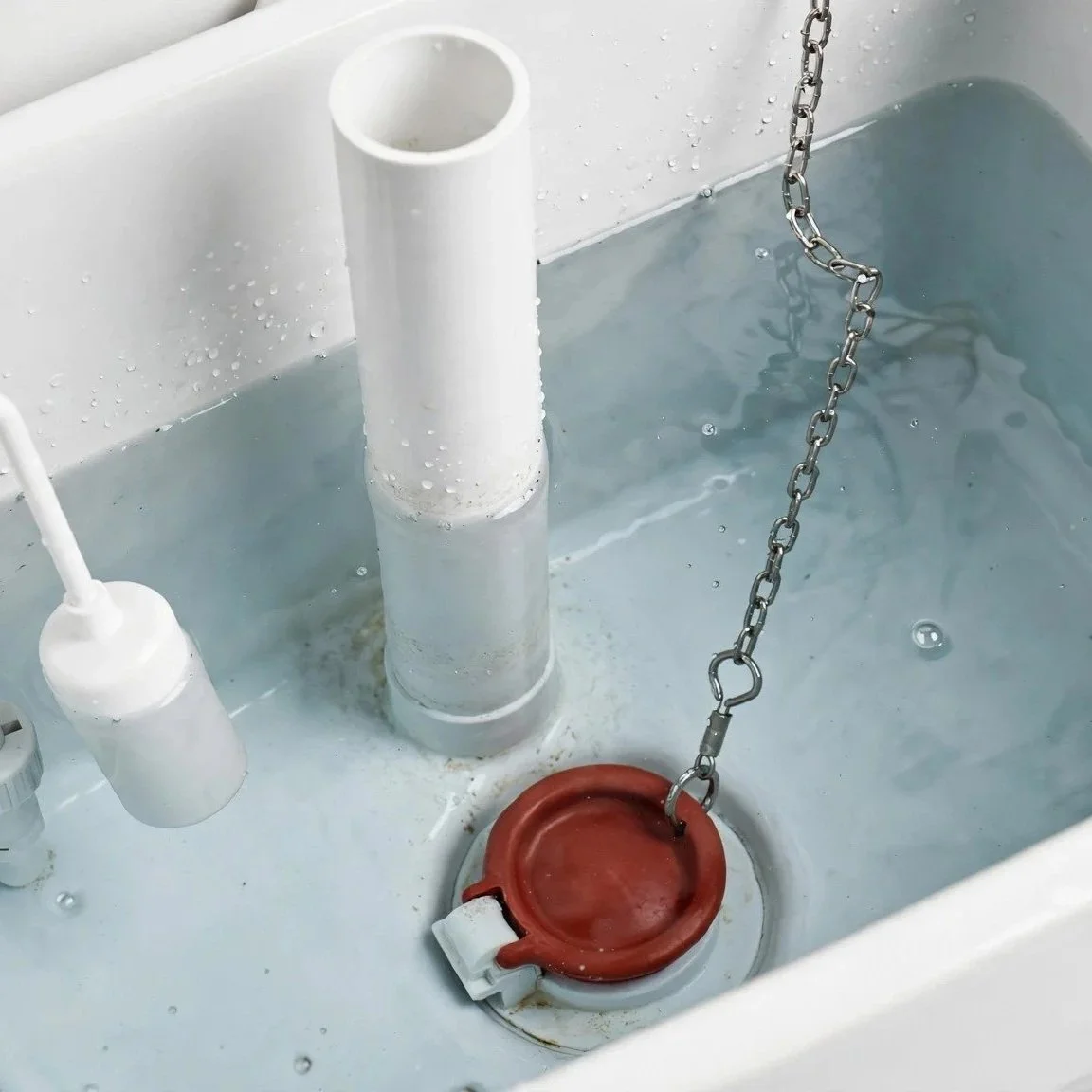
A toilet that keeps running is almost never a mystery once you understand what lives inside the tank. In nearly every case, one small part has stopped doing its one job: either something will not seal, so water leaks out of the tank as fast as it fills, or the fill valve will not shut off, so it keeps pouring in. Either way, the toilet runs and runs, and the meter keeps turning even when nobody is in the room.
How the Tank Cycle Actually Works
Before chasing the noise, it helps to know the sequence the tank runs through every time you flush. Once you see the cycle, the failure points stand out on their own.
The flush: You push the handle. A lift chain pulls up the flapper (the rubber or silicone seal at the bottom of the tank), uncovering the flush valve opening.
The drain: Tank water rushes down through the flush valve into the bowl, pushing waste through. The tank empties in a few seconds.
The reseal: With the tank empty, the flapper drops back down and seals the flush valve opening so the tank can hold water again.
The refill: As the water level fell, it dragged the float down with it. That opened the fill valve, which now pipes fresh water back into the tank (and a small stream down the overflow tube to refill the bowl).
The shutoff: Water rises, the float rises with it, and when the float reaches its set height it closes the fill valve. Silence. The tank sits full and still until the next flush.
The Common Causes, From Most Likely to Least
A worn or misaligned flapper (the number-one cause): The flapper takes the most abuse of any part in the tank. It sits in standing water its whole life, and rubber ones slowly harden, warp, or grow a slick mineral film. Once it stops making a clean seal, tank water dribbles down into the bowl around the clock. The level drops, the float drops, and the fill valve clicks on to top it back up, over and over. That is the classic "phantom flush," where the toilet refills for a few seconds every several minutes with nobody touching it. A flapper that has gone stiff, curled at the edge, or coated in scale is the single most common reason a toilet runs.
A flapper chain that is too short, too long, or tangled: The chain connecting the handle to the flapper needs a little slack, roughly half an inch. Too short, and it holds the flapper slightly open so it never fully seals. Too long, and it can slip under the flapper and prop it up, or tangle around the flush lever. A chain kinked around itself is a surprisingly frequent cause of a toilet that runs right after a flush and will not settle.
A float set too high: If the float is adjusted too high, the fill valve keeps running past the point where the tank is full. The extra water has nowhere to go but into the overflow tube, the open vertical pipe in the middle of the tank, which drains straight to the bowl. The result is a fill valve that never shuts off and a steady trickle you can see running into the overflow. Lowering the float so the water stops about an inch below the top of the overflow tube usually settles it.
A fill valve that will not shut off: The fill valve itself can wear out. Grit, mineral scale, or a failed internal seal keeps it from closing fully even when the float has risen all the way. When the valve is the problem, adjusting the float does nothing, the water level looks correct, and the valve still hisses. A fill valve that hisses with a correct water level has usually reached the end of its life and needs replacing.
A fill valve that will not shut off: The fill valve itself can wear out. Grit, mineral scale, or a failed internal seal keeps it from closing fully even when the float has risen all the way. When the valve is the problem, adjusting the float does nothing, the water level looks correct, and the valve still hisses. A fill valve that hisses with a correct water level has usually reached the end of its life and needs replacing.
A cracked overflow tube: Less common, but worth checking: if the overflow tube itself is cracked below the top rim, water drains into the bowl continuously no matter how the flapper and float are set. A tube that is broken low on its shaft usually means replacing the whole flush valve assembly.
How to Diagnose It Yourself
The food-coloring test. Take the tank lid off and add several drops of food coloring to the tank water. Do not flush, and wait about fifteen minutes. If colored water shows up in the bowl, the flapper or seat is leaking, and that leak is your running toilet. Clear water in the bowl means the flapper is working and points you toward the float or fill valve instead.
The food-coloring test. Take the tank lid off and add several drops of food coloring to the tank water. Do not flush, and wait about fifteen minutes. If colored water shows up in the bowl, the flapper or seat is leaking, and that leak is your running toilet. Clear water in the bowl means the flapper is working and points you toward the float or fill valve instead.
Check the water line against the overflow tube. Lift the lid and look at where the water settles. If it sits at or above the top of the overflow tube and spills in, the float is too high, or the fill valve is not shutting off. If it settles an inch or so below the tube top and holds there, the fill side is fine, and your leak is at the flapper.
Diagnosing a running toilet is like tracing a drip back to its source: you follow the water. Coloring reaching the bowl means the leak is above the flapper; water pouring into the overflow means the leak is on the fill side. One test tells you which half of the tank to work on.
The DIY Fixes
Before you touch any part inside the tank, reach down and close the supply valve on the wall behind the toilet, turning it clockwise until it stops. Then flush to empty the tank. Skipping this step is how a simple fix turns into a wet floor.
Replace the flapper: Unhook the old flapper from the pegs on the overflow tube and unclip the chain. Take it to the store to match the size and style, since flappers are not universal. Snap the new one on, reconnect the chain with about half an inch of slack, turn the water back on, and run the food-coloring test again to confirm the seal.
Adjust the chain or float: If the chain is tangled or badly sized, reset it so the flapper closes fully with a little slack. To lower a float, turn the adjustment screw on a modern column-style fill valve, or gently bend the float arm down on an older ball-style setup, until the water stops about an inch below the overflow tube.
Clean the seat: With the water off and the tank empty, wipe the flush valve seat with a rag or a plastic scouring pad to lift mineral scale and grime. Avoid metal tools that could scratch the plastic and worsen the seal.
Replace the fill valve: If the valve hisses with the water level correct, swap it. Fill valves are sold as a universal kit and thread into the same hole in the tank bottom. Hand-tighten the mounting nut and give it only a small final turn, since these are plastic and overtightening can crack the tank or the valve.
One habit worth dropping while you are in there: skip the drop-in tank tablets that contain bleach. They sit in the tank and slowly eat the rubber flapper and seals, which is often what put you on this page in the first place.
When to Call a Plumber
Most running toilets are a fifteen-minute part swap. Call a professional when the problem outlasts the easy fixes or when the hardware itself is failing.
Bring in a plumber if the toilet keeps running after you have replaced the flapper and fill valve, which points to a cracked flush valve seat or a warped tank component that needs the whole flush valve assembly rebuilt. Call right away if you see a crack in the tank body or the valve, since a cracked tank can let go without warning and flood the floor, and it is not a patch job. Homes on hard water often chew through flappers and seats faster than parts can keep up, and a plumber can fit longer-lasting components and check whether scale is damaging the seat. If the supply valve behind the toilet is seized or drips when you turn it, that is a plumber's call too, since a stuck shutoff leaves you no safe way to work on the tank.
Frequently Asked Questions
How much water does a running toilet actually waste?
A toilet with a leaking flapper can lose hundreds of gallons a day, and a badly stuck fill valve can push past a gallon every few minutes. Because the loss is silent and continuous, it often shows up first as a jump on the water bill rather than a visible problem, which is why fixing it promptly matters even when the trickle seems small.
Are flappers interchangeable between toilets?
No. Flappers come in different diameters (commonly two-inch and three-inch) and in several mounting styles, and some newer toilets use a seal disk instead of a hinged flapper entirely. The safest approach is to bring the old part to the store to match it, or read the toilet's model number stamped inside the tank, rather than assuming any flapper will fit.
Why does my toilet run for a few seconds and then stop, over and over?
That intermittent cycling is the fill valve topping up water that is slowly escaping through a flapper that almost seals but not quite. The tank drops just enough over several minutes to trip the float, so the valve runs briefly and shuts off again. It is the same flapper leak as a steady run, only slower, and the food-coloring test will still confirm it.
Can hard water be the reason my flapper keeps failing?
Yes. Mineral-rich water leaves scale on the flapper and on the flush valve seat, and that gritty film keeps the two from sealing cleanly. Homes with hard water tend to go through flappers faster, and silicone flappers generally resist scale buildup better than the older rubber style.
Is it safe to leave a running toilet overnight?
It will not harm the toilet, but it wastes water the entire time and can slowly overflow the tank into the overflow tube for hours. If you cannot fix it right away, close the supply valve on the wall behind the toilet to stop the flow, then reopen it when you flush. That stops the waste without leaving standing water where it should not be.
Can a running toilet leak out the bottom instead of into the bowl?
Yes, and it is worth telling apart from an internal leak. If the level drops but the bowl stays quiet and you find water or a musty smell on the floor around the base, the culprit is usually the rubber tank-to-bowl gasket or the two brass tank bolts, not the flapper. That kind of leak drips onto the flange and subfloor rather than cycling back into the bowl, so it can rot the floor unnoticed. A tank-to-bowl leak calls for pulling the tank and swapping the sponge gasket and bolt washers, a different repair from a flapper or fill valve, which is why pinning down where the water actually goes matters before you buy parts.