
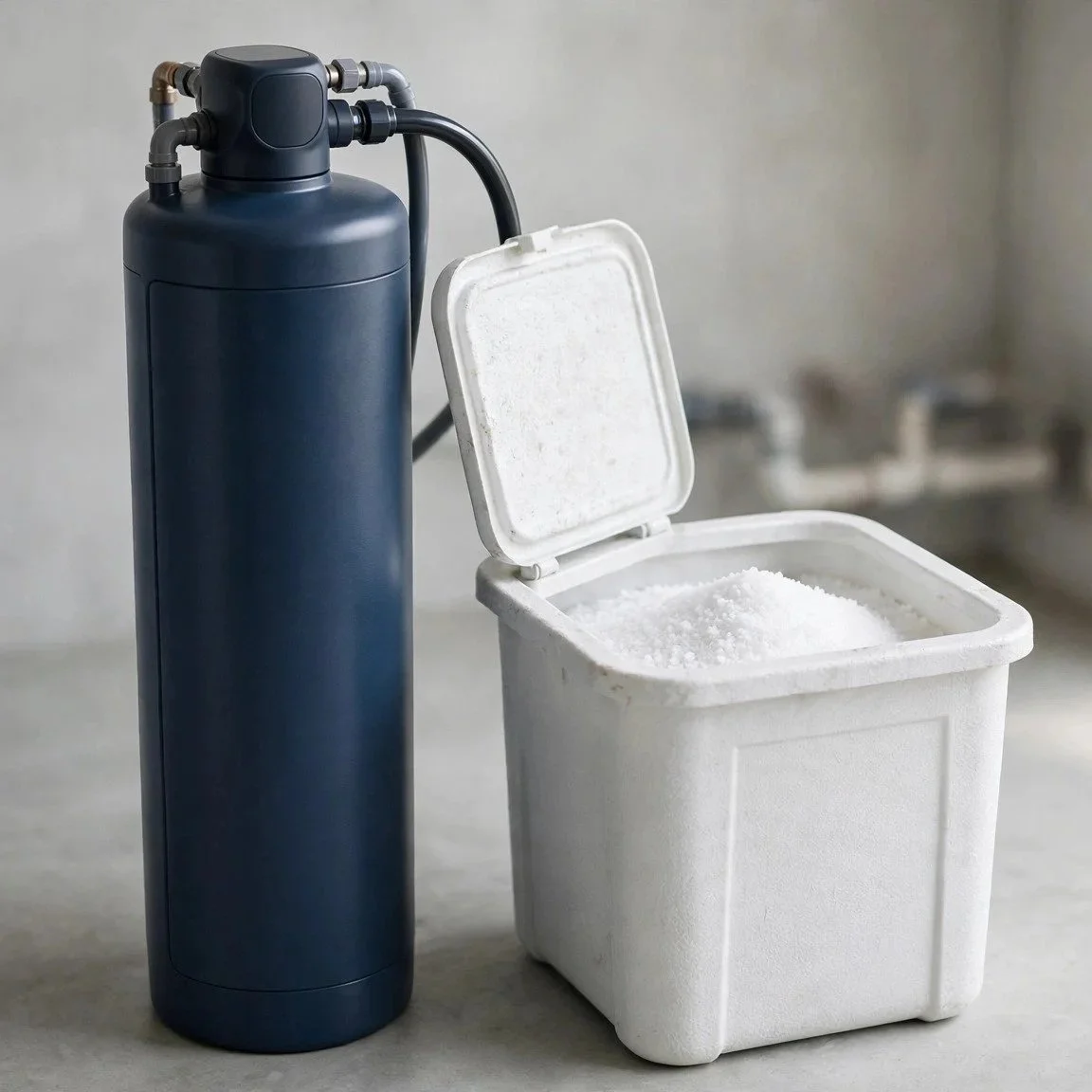
Hard water carries dissolved calcium and magnesium. Those two minerals are the reason a kettle scales up, a shower head clogs, and soap refuses to foam. A softener exists to pull them out before the water reaches the rest of the house, and when it quietly stops doing that job, the hard-water symptoms all come back at once. The frustrating part is that the unit often looks fine from the outside while it fails on the inside.
How A Water Softener Actually Removes Hardness
The heart of the system is a tank filled with thousands of small plastic resin beads. Each bead carries a negative charge and holds onto sodium (or potassium) ions. As hard water flows through, the calcium and magnesium, which carry a stronger positive charge, trade places with the sodium clinging to the beads. The hardness minerals stay stuck to the resin, and softened water carries the released sodium out to the taps. That swap is called ion exchange.
The catch is that the beads eventually fill up with calcium and magnesium and run out of sodium to trade. So the softener periodically cleans itself in a step called regeneration. A control valve floods the resin tank with a strong salt solution, or brine, drawn from a second tank where you pour the salt. The concentrated brine forces the hardness minerals off the beads, recharges them with fresh sodium, and then flushes the calcium and magnesium down the drain. After a rinse, the resin is ready to soften again.
A softener is a lot like a rechargeable battery for water. It holds a fixed capacity, works hard until that capacity is spent, then plugs itself back in to recharge. If the recharge cycle is broken, or the battery itself is worn out, you get the same result: it simply stops delivering.
Almost every failure traces back to one of those two parts, the resin or the regeneration cycle. Knowing which one is off tells you whether it is a quick fix at the salt tank or a call for service.
The Tell-Tale Signs Something Has Failed
Softeners rarely die with a dramatic bang. The clues build slowly, and catching them early saves the plumbing downstream from a fresh coating of scale.
Spotty dishes and cloudy glassware: Clean glasses that dry with white speckles or a hazy film are one of the earliest flags. Those spots are calcium and magnesium left behind as the water evaporates. Softened water dries clear.
Soap that will not lather: Hardness minerals react with soap and strip its ability to foam. If shampoo, dish soap, or hand soap suddenly feels stingy and you are using more to get the same suds, the water going to the tap is no longer soft.
The slippery feel is gone: Soft water has a distinct slick, almost slippery feel on the skin because there is nothing left to bind with soap and form a residue. When showers start to feel squeaky or filmy again, the softener has likely stopped exchanging.
Scale creeping back onto fixtures: Chalky crust on faucet aerators, a cloudy shower door, or mineral rings inside the kettle returning after months of clean surfaces all point to hardness sliding through untreated.
The salt level never drops: Peek in the brine tank. If the salt sits at the same height week after week, the system is not drawing brine, which means it is probably not regenerating at all.
No sign of a regeneration cycle: Many units run their cycle overnight. If you never hear the valve running or notice water moving to the drain, and the softened feel has faded, regeneration may have stalled.
What Is Actually Going Wrong Inside
Behind those symptoms sits a short list of usual culprits. Some you can handle. Some belong to a plumber.
Salt bridge in the brine tank: A hard crust of salt can form a bridge across the tank, leaving an empty pocket of air underneath. The water sits below the bridge and never touches the salt, so no brine gets made and the resin never recharges. From the top it looks like there is plenty of salt.
Salt mushing at the bottom: The opposite problem is salt that dissolves and recrystallizes into a thick sludge at the base of the tank. This mush blocks brine flow and can plug the system. Mushing is more common with certain salt types and in humid conditions.
Fouled or worn-out resin: Resin beads do not last forever. Iron, sediment, and chlorine slowly foul or break them down, and after many years they lose the capacity to hold sodium and swap it out. Worn resin cannot soften no matter how much salt you add.
A stuck control valve or dead motor: The valve is the traffic controller that shifts the unit between softening, brine draw, backwash, and rinse. A failed motor, a jammed piston, or a worn seal can freeze it in one position so regeneration never completes.
The wrong regeneration setting: If a power outage reset the clock, or the day and time were programmed incorrectly, the unit may try to regenerate at the wrong moment or count the wrong hardness level. It runs, but out of step with actual use.
A clogged injector or venturi: A small injector creates the suction that pulls brine into the resin tank. Sediment can clog that tiny passage, and without suction the brine never moves, so the beads never recharge even when everything else looks normal.
Checks You Can Safely Do Yourself
Before assuming the worst, a few minutes at the tank rules out the simple stuff. Keep hands out of the internal valve and plumbing, but the salt side is fair game.
Confirm the salt level and look for a bridge: Open the brine tank lid. Salt should generally sit at least a third full and above the water line.
Check the bypass valve position: Many softeners have a bypass so water can skip the unit during service. If someone flipped it, hard water routes straight past the softener. Follow the inlet and outlet lines and confirm the valve handle or knob is set to service, not bypass.
Verify the time and regeneration settings: On the control head, check that the current time of day is correct and the regeneration schedule looks reasonable. A clock knocked off by a power blip is a common, harmless reason a unit quits softening. Reset it to the right time following the owner's manual.
Watch for a manual regeneration: Most control heads allow you to trigger a regeneration by hand. Start one and listen. You should hear water moving and, over the next hour or two, see the salt level begin to draw down. If nothing happens, the problem is deeper than salt.
When To Bring In A Plumber
Salt checks and a clock reset are the safe end of the job. Anything past the brine tank, meaning the control valve, the motor, the resin bed, or the drain and plumbing connections, is service work. Opening the valve body, replacing resin, or reconnecting drain lines calls for a professional who can test hardness, diagnose the valve, and confirm the fix without damaging the unit or the surrounding plumbing.
A plumber is the right call when the salt level is correct, and there is no bridge, yet the water is still hard; when a manual regeneration does nothing; when the valve makes grinding noises or leaks; or when the unit is old enough that worn resin is the likely story. A quick hardness test on the treated line tells the tech whether the resin is finished or the valve is the fault.
One note worth remembering: because ion exchange releases a small amount of sodium into softened water, anyone on a strict low-sodium diet may want a potassium-based salt or a separate unsoftened tap for drinking. It is a modest amount, but worth a mention to a doctor if sodium intake is closely watched.
Frequently Asked Questions
How long does the resin inside a softener usually last?
Resin typically lasts about 10 to 15 years, though heavy chlorine in municipal water can shorten that to 5 to 10 years by oxidizing the beads. Water with iron ages resin faster still. Some homeowners extend resin life by adding a resin-cleaning product a few times a year to strip iron fouling before it becomes permanent.
Can I use my water while the softener is being repaired?
Yes. Set the bypass valve to bypass, and the house runs on untreated water with normal pressure, so faucets, toilets, and appliances all work fine; you get hard water temporarily. Leaving a softener in bypass for a few days causes no harm, but running the water heater on hard water long-term will speed up scale buildup on its heating element.
Does a softener remove more than just hardness minerals?
Not really. Standard ion-exchange softeners target calcium and magnesium, plus small amounts of dissolved iron and manganese. They do not remove chlorine taste, bacteria, nitrates, or lead, which is why homes wanting drinking-water quality often pair the softener with a separate carbon filter or reverse-osmosis unit at the kitchen sink.
Why does my softened water sometimes taste salty?
A salty taste points to a stuck valve that failed to complete the final rinse, leaving leftover brine in the tank instead of flushing it to the drain. It can also mean the regeneration frequency is set too high for the household size. A single salty batch after a cycle can be normal, but a persistent salty taste is a service flag.
How much salt should a working softener go through?
A typical family unit uses roughly one 40-pound bag of salt per month, though this shifts with water hardness, household size, and how the unit is programmed. If you find yourself refilling far more often than that, the system may be regenerating too frequently. If a bag lasts many months, it may not be regenerating at all.
What is the difference between rock salt, solar salt, and pellets?
Rock salt is the cheapest but carries the most insoluble impurities, which build up as sediment and increase the odds of mushing at the tank bottom. Solar salt (evaporated crystals) is purer, and pressed pellets are the cleanest and least likely to bridge. Mixing salt types in one tank can actually encourage bridging, so pick one form and stay with it.