A flush is a chain of small events that must be completed for a toilet to clear on its own. Water releases from the tank through the rim openings and the jet at the bottom of the bowl, filling the curved trapway until enough is moving to start a siphon, which pulls the bowl's contents through and out. A toilet that clogs once can be nothing more than the wrong item at the wrong moment. A toilet that clogs over and over is one where the siphon keeps losing, and the pattern behind each clog indicates whether the cause lies inside the toilet or somewhere beyond it.
Each clog pattern, its likely cause, and which way the decision leans:
| Pattern | Likely Cause | Which Way It Leans |
|---|---|---|
| Clogs at the same toilet with ordinary use, while other drains run fine | An object lodged in the trapway | Repair: clear it |
| A plunger clears it, but the next few flushes come back weak | Partly blocked rim openings or jet | Repair: clean and descale |
| Clogs began right after a child's toy or a wipe went down | An object lodged in the trapway | Repair: retrieve it, possibly pulling the toilet |
| A weak swirl and a slow-filling bowl, even when nothing is stuck | Narrowed rim openings or jet, or a flush design that never cleared well | Clean first; replace if it persists |
| Clogs at this toilet together with gurgling or a slow tub or sink nearby | A partial blockage in the branch or main line | Clear the line |
| An older low-flush toilet that has always needed a second flush | A trapway or flush design that was undersized from the start | Replace |
How the Siphon Clears the Bowl
When the handle is pressed, a flapper lifts off the flush valve in the tank floor, releasing the water sitting there. That water splits: some goes out through the rim openings around the underside of the bowl's rim, and the rest goes straight down through the jet, a single larger opening aimed into the trapway. The jet's job is to get water moving fast enough, in the right direction, to fill the trapway completely rather than splash through it. Once the trapway is full and the water inside it forms a single column, it creates a siphon: the falling column lowers the pressure behind it, and that drop draws the waste in the bowl through the trap and into the drain below. The siphon breaks on its own once air returns to the trapway, at which point the bowl refills through the rim openings and remains still until the next flush.
Every part of that sequence has to hold for the bowl to clear in one flush: enough water, moving fast enough, through a trapway wide enough to let it pass. A clog that keeps returning to the same fixture can mean one part of that sequence keeps failing.
An Object Lodged in the Trapway
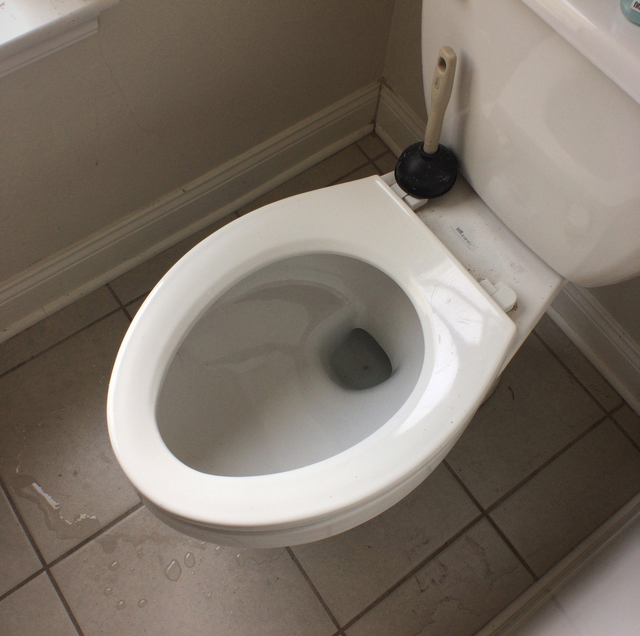
An object caught in the trapway's curve blocks the water column from forming rather than blocking the bowl outright, which is why the toilet can look like it's clearing between clogs. A plunger works by forcing water back and forth against whatever is in the way, and that pressure wave can push water around a hard, rigid object, such as a toy or a bottle cap, without moving the object itself. The bowl drains because water found a path past the obstruction, and the next flush catches on the same spot because the object never left.
Retrieving a hard object wedged in the trapway can mean pulling the toilet off the flange, since a plunger pushes water around it and a closet auger's cable can slide past it without hooking it. That work falls to the plumber: the toilet is raised, the object is cleared from the trapway, and the toilet is reset and resealed. Lifting a toilet also exposes the wax seal and the flange, which are a separate subject from the clog.
A toilet bowl and tank are heavy porcelain that chips and breaks into sharp-edged pieces when lifted unevenly. Pulling a toilet to reach a lodged object is a job for the plumber.
Rim Openings and the Siphon Jet
The rim openings and the jet are narrow by design, sized to move a fixed volume of water into a specific pattern. Anything that narrows them further weakens that pattern: mineral deposits building up inside a rim opening reduce how much water flows out of it, and a jet carrying the same deposits along its edge sends a weaker, less directed stream into the trapway. Neither failure blocks the passage outright, as an object does. Instead, the flush becomes less able to build the fast-moving water column that the siphon depends on, so the bowl empties slowly or only partway, and any solid waste in it is more likely to be left behind on the next attempt.
This kind of narrowing develops gradually and shows up as a weak, uneven swirl during the flush and a bowl that takes longer to refill and settle, rather than as a sudden clog. Mineral scale forming on fixtures is its own mechanism with its own causes and its own fix. For clogging, what matters is that scale on the rim or jet is a flow problem before it's ever an object-lodged problem, and cleaning the openings can restore flush strength without any part replaced.
What Goes Down the Toilet
Toilet paper is engineered to lose its structure once it's wet and moving, breaking into small pieces that pass easily through a trapway sized for exactly that. Wipes marketed as flushable, paper towels, cotton products, and similar items are not built the same way. They hold together in water long enough to reach the trapway's curve still intact enough to catch, and once one catches on a narrow point or a rough patch, it becomes the surface the next piece of paper or waste sticks to. A single wipe does not have to block a trapway outright for it to matter: a toilet that gets even an occasional wipe flushed down it can develop repeat clogs for a different reason than one that only ever sees toilet paper, because it is accumulating a snag point instead of washing clean every time.
The same applies to dental floss and cotton swabs, neither of which breaks down in water the way toilet paper does. Clogs that began after a household habit changed are worth checking against what is being flushed before the toilet itself is blamed. Chemical drain cleaner has no place in a toilet: it can heat and splash, damage the porcelain, and burn whoever works on the toilet next.
When the Problem Is Past the Toilet
Some clogs that show up at the toilet start past it. When the toilet backs up while a nearby tub or sink also runs slowly, the restriction is in the branch or main line those fixtures share, and plunging the bowl leaves it where it is. A toilet that gurgles when another fixture drains is due to venting and shared-line issues. Clearing a shared-line restriction means cabling or jetting the line itself.
Repair or Replace
A toilet that clogs repeatedly because of an object, narrowed rim openings and jet, or worn flush-valve or fill-side parts is a repair, not a replacement: clearing the object, cleaning and descaling the openings, and swapping the worn parts can restore the flush a working toilet is supposed to have, and none of that changes what the toilet is.
Replacement is the answer when the trapway itself is the limiting factor. A cracked or chipped trapway does not go back to sealed and smooth with cleaning. A bowl that has never cleared reliably since it was installed, and continues to struggle after the rim openings and the jet have been cleaned and every part inside the tank checked, with the line past it clear, has a design or manufacturing limitation that repair cannot reach: the flush geometry itself is undersized for what it is being asked to move. In either case, the answer is a new toilet.
Frequently Asked Questions
Is it risky to flush a clogged toilet a second time?
Yes. A bowl that is already full can overflow on a second flush, so the toilet's wall-mounted water valve is turned off instead, and any spilled wastewater is cleaned up with gloves. Repeat flushing can also drive a wipe past the trapway into the branch drain, beyond a plunger's reach in the bowl.
Does wiping down the rim under the bowl's edge restore a weak flush?
Not on its own. The openings that release water during a flush sit up under the rim lip and angle inward and down, out of sight and out of reach of a cloth or sponge; clearing the deposit inside them can take a pick or a small brush worked into each opening, not cleaning the visible rim surface.
How can the flush show whether the rim or the jet is narrowed?
Clear rim openings send water down the bowl at an angle in a swirl; narrowed ones let it trickle or run in uneven streaks. A narrowed jet shows at the bottom instead: the bowl rises during the flush and drains slowly without the sharp pull of a full siphon.
Does adding a water-saving device inside the tank make a marginal toilet clog more?
It can. A device that displaces water in the tank reduces how much reaches the trapway on each flush, and a toilet whose siphon already depends on every bit of that water to complete can start leaving waste behind once less of it arrives, a change caused by what's inside the tank, not by anything wrong with the toilet itself.
Can a toilet auger scratch the bowl?
It can if bare cable touches the porcelain. A closet auger feeds its cable through a bent tube with a protective sleeve at the bowl end, so the metal stays off the glaze; an ordinary drain snake has no such guard and can leave gray marks or chip the finish.
Does the kind of plunger matter on a toilet?
It does. A flange plunger has a soft extension that fits into the bowl's outlet and seals there, so each push moves water into the trapway. A flat cup plunger made for sinks cannot seal on the curved outlet and moves little water past the bowl.
Order a toilet repair or replacement — trapway clearing, rim and jet descaling, and a new toilet when the bowl or trapway is beyond repair. Jimmy Joe's Plumbing serves Mesa, Phoenix, and the Valley. ROC 273293. Call (480) 757-1273.