
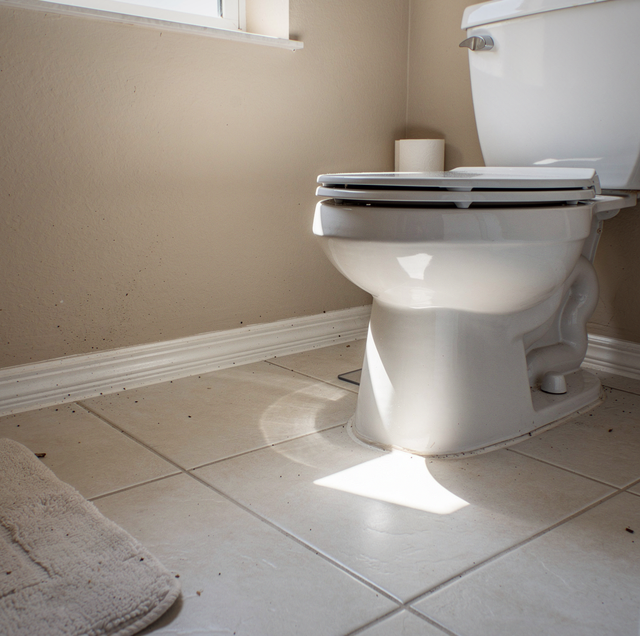
You sit down and the whole bowl shifts, just a little. Maybe it only moves toward the tank side, or maybe it rocks both ways when you shift your weight. Either way, a toilet is not supposed to move at all once it is bolted down: a bowl that rocks is the first sign that something holding it to the floor has already let go.
Why a Toilet Starts to Rock
A toilet bolts to a fitting called a closet flange, which is anchored to the drain pipe below the floor. Two closet bolts rise up through slots in the flange, pass through matching holes in the base of the bowl, and a nut on each one clamps the porcelain down snug against the floor. When every part of that connection is doing its job, the bowl sits rigid, with no give in any direction.
A few different failures produce the same rock. The nuts on the closet bolts have backed off. A flange sitting proud of the finished floor tips the bowl up onto its edge rather than letting it sit flat, and the bowl rocks no matter how tight the bolts are turned. The flange can also wear or crack at the slots where the bolts pass through, leaving nothing solid for the bolt heads to bite against, even when tightened. Each of these leaves the base free to pivot under your weight, and once it can move, it keeps moving every time someone sits down.
Press the tank gently instead of the seat to isolate the problem. If the tank shifts but the bowl stays planted, loose tank-to-bowl bolts are the cause, a lighter fix than a failing floor seal.
The Seal Below Takes Every Rock
Under the base of every toilet sits a ring seal, bridging the gap between the horn on the underside of the bowl and the opening of the flange. That seal does two jobs at once: it keeps wastewater contained as it enters the drain, and it holds the bowl centered over the opening so nothing hits a lip or an edge on the way down.
A seal only works under even, constant pressure. A bowl bolted down tight compresses the ring evenly all the way around. A bowl that rocks flexes the ring on one side and relieves pressure on the other, over and over. Each rock follows a slightly different path through the ring, and a seal that has been flexed rather than held still gradually loses its shape at the point where the pressure keeps shifting. Once the ring can no longer bridge that gap cleanly, water finds the opening it left behind. This is a leak at the base of the toilet itself, a different failure from a tank that keeps refilling because a part inside it will not shut off.
How the Flange Takes Damage Alongside the Seal
Rocking does not stop at wearing out the seal. Every shift in the bowl also loads the closet bolts, which transmit that stress directly into the flange. A metal flange generally tolerates this longer, but a plastic flange can crack at the bolt slots under repeated flexing, since that is the narrowest, most stressed point on the ring. Once a slot splits, the bolt on that side has nothing rigid to clamp against, no matter how hard the nut is turned, and the rocking gets worse rather than better.
A flange recessed below the finished floor leaves the ring seal short of the bowl's horn, so it never compresses fully, and water gets past it on every flush.
Where the Water Goes Once the Seal Breaks
Water from a failed base seal travels down through the gap left by the broken seal into the flange opening and the subfloor around it. A tank-side leak takes a different path: it drips or trickles down the outside of the bowl from the tank joint and pools where you can see it right away.
Because the leak occurs below the toilet's footprint, the water reaches the wood or backer board beneath the flooring before any signs appear on the surface. What does show appears at the very edge of the base: a bead of water at the joint where the porcelain meets the floor, a dark spot or mold forming along the caulk line where moisture keeps returning, a smell that is faintly present near the floor and not from the bowl itself, or caulk that keeps cracking along the base no matter how many times it gets redone. The leak is often worse right after a flush, when the drain line briefly carries a rush of water past the compromised seal, and nearly silent the rest of the time, which is part of why it can run for a while before anyone connects the dots.
Signs in a Softened Subfloor
Once enough moisture has reached the wood beneath the flooring, the floor itself starts to tell on the leak. A spot near the base that gives slightly underfoot, more than the surrounding floor, points to wood that has begun softening from repeated exposure to water it was never built to handle. Tile grout around the base of the toilet can develop a ring of cracks as the subfloor beneath it loses its rigidity and flexes under weight it used to support without complaint. Vinyl or laminate near the base may look discolored, cupped, or slightly raised compared to the rest of the room. In a bathroom with a floor below it, a stain or sag on the ceiling underneath confirms that water has been traveling through the subfloor for some time.
None of these signs on their own prove how long the leak has been active, and a guessed timeline changes nothing about what the floor is showing right now. A base that rocks but shows none of these signs yet is still worth fixing immediately, because every rock flexes the seal, even if it has not let water through yet.
Lifting a toilet off its seal breaks the barrier to the drain line, exposing the room to sewer gas and waste-line water. A plumber breaks that seal only when resetting it right away, so leave lifting the bowl to the plumber.
How a Plumber Decides Between a New Seal, a Flange Repair, or More
Fixing a rocking toilet starts with figuring out which part actually failed, since a new ring seal does nothing if the flange underneath it is the real problem. A plumber lifts the bowl, inspects the flange face, bolt slots, and the flange height relative to the finished floor, and checks the subfloor around the opening before deciding on a repair.
| What the inspection finds | What it points to |
|---|---|
| Flange intact, correct height, seal simply broke down | A new ring seal, bowl reset and rebolted on the existing flange |
| Flange sits noticeably below the finished floor | Flange height corrected to the finished floor before resealing |
| Flange cracked at the bolt slots or otherwise damaged | A flange repair ring, or replacement of the flange section |
| Subfloor soft, discolored, or spongy under the old fixture | Subfloor material repaired before the toilet is reset on top of it |
The order matters because each layer sits on top of the one below it. Resealing a bowl onto a flange that is still too low leaves the same leak in place, and bolting it down over subfloor that has already gone soft leaves the same rocking. A flange that has failed structurally, or a subfloor section that has taken on water, changes the scope of the job well beyond swapping a ring seal, which is exactly why the inspection has to come before any part gets replaced.
Frequently Asked Questions
Can a cracked toilet base cause rocking on its own?
Yes, and it is worth ruling out before assuming the flange or seal is the problem. A hairline crack in the porcelain foot of the bowl, which may be invisible without close inspection, allows the base to flex slightly under weight, even with a perfectly sound flange and a fresh seal underneath it. A cracked base cannot be repaired and calls for replacing the toilet itself, not just resealing it.
Will tightening the bolts myself stop the rocking?
Turning the nuts down further can mask the symptom briefly, but porcelain cracks easily under uneven pressure, and a bolt cranked down hard against a base that is not sitting flat is a common way that crack happens. If the bowl still rocks after the bolts are snug, the cause is below the bolts: a flange at the wrong height, a cracked slot, an uneven floor, or a cracked foot. Forcing the bolts tighter only raises the odds of damaging the bowl itself.
Where exactly should the flange sit relative to the finished floor?
The flange belongs on top of the finished floor, flush with it or extending up to about a quarter inch above, so the bowl's horn seats squarely on the ring below it. When a floor gets built up with a second layer of tile or vinyl and the flange is never raised to match, a plumber can stack a flange spacer or extender ring onto the existing flange to bring it back to the correct height instead of cutting out and resetting the fitting.
Does a rocking toilet always mean the subfloor is already damaged?
Not necessarily. Rocking caused solely by loose closet bolts or a flange set at the wrong height can appear before the seal has broken down enough to let water through, meaning the subfloor may still be dry. A soft or spongy spot underfoot, on the other hand, confirms that water has already reached the wood, which is a separate finding from the rocking itself and changes what the repair needs to cover.
Are shims a real fix or just a temporary patch?
Shims placed under a rocking base can stabilize it in the short term, but they only address the symptom, not the cause of the bowl not sitting flat in the first place. If shims are needed because the flange sits at the wrong height or the floor beneath it is uneven, the rocking comes back once the shims compress or shift, which is why a shimmed toilet is worth having inspected rather than left as a permanent solution.
What is a wax-free seal, and does it stop a toilet from rocking?
A wax-free seal is a rubber or foam ring that performs the same sealing function as a traditional wax ring but can be reseated multiple times without losing its shape, making it useful when a toilet has to come off and go back on for inspection. It does not, by itself, fix rocking caused by a cracked or misaligned flange, since the seal is not what anchors the bowl to the floor. A wax-free seal solves the sealing half of the problem; the flange and bolts still have to be sound for the bowl to sit still.
Have a rocking toilet reset and resealed before it takes the subfloor with it — get the flange checked, and the leak stopped at the source. Jimmy Joe's Plumbing serves Mesa, Phoenix, and the Valley. ROC 273293. Call (480) 757-1273.