
You wake at five to a sound that does not belong in your house. Water is running behind your bedroom wall, steady and even, and nobody in your family turned anything on. Your feet hit wet carpet before you find the switch, and your socks get soaked before you reach a light.
What you do in your first two minutes matters more than anything you do in the next two hours. You cannot repair the pipe, and nobody expects you to. But the order in which you move affects how far the water gets into your house, how much your floors cost to dry, and whether anyone in your family gets hurt reaching for the wrong thing. Here is your order, and the water is not first.
Get Everyone Away From the Water First
The instinct is to go straight at the water with towels and start fighting it. Hold that for sixty seconds. Water on a floor is a slow problem, and it is a property problem. The fast problem is a person, usually standing in the same room. Account for everyone who lives there, including the ones who sleep through noise, and get small children and pets out of the wet rooms before anything else happens.
The reason is electricity. A supply line that lets go inside a wall does not stay in that wall. It runs down framing and out across a floor, and the things sitting on that floor are power strips, extension cords, appliance plugs, and sometimes the bottom of a panel. A circuit stays live with water standing on it, and a breaker that has not tripped proves nothing, because a breaker trips on current and not on wet. If water has reached any electrical equipment, that room is closed to everyone in the house until someone qualified has killed it.
So the first minute holds two moves and no more. Get people out of the wet rooms, and send one person in dry shoes to the main water shut-off. The photographs, the towels, the phone calls and the furniture all wait, and they wait cheaply, because not one of them gets worse in the next sixty seconds.
Standing water that has reached outlets or a panel can shock anyone who steps in it. Never wade in to reach or reset a breaker; have a licensed electrician or the utility de-energize it.
Stop the Water, Then Take the Pressure Out of the Line
Step two is the water, and it really is one step: close the main. This page is not going to teach you where that valve sits or how it turns, because knowing that in advance is its own subject and an emergency is a poor classroom. If you know, go now. If you do not know, and one minute of looking has not turned it up, stop looking, call the water utility, which can shut the service at the street, and call a plumber.
Then comes the step almost nobody takes, and it is the one that saves your floor. Closing the main does not empty your house. Every foot of pipe above the break still holds water, and that water keeps leaving through the break under nothing but gravity until the line is empty. Open the lowest cold fixture you have, a tub spout on the bottom floor or a laundry sink, and let the system drain out there instead of through your ceiling.
Open a tap upstairs afterward as well, which lets air in behind the draining water and empties the line faster. Then watch the break for a few minutes. Flow that thins to a drip was supply water leaving on schedule. Flow that holds steady is water still arriving from somewhere, and that changes who you need and how soon.
The Hot Side Is Its Own Problem
If the water leaving the break is steaming, or the room fogs up, the break is on the hot side, and that water is at whatever temperature the tank holds. That is hotter than skin tolerates, and it does not cool crossing a room. The reflex is to reach through the spray and close the nearest valve with bare hands. Do not reach into hot water to escape, and do not hand-close a valve on a hot line to stop the flow: the plumber isolates the water heater and lets the tank cool before anything on that side is opened.
Shutting the heater down is the plumber's step, not yours, regardless of the fuel it burns, and the reason is the one that keeps you off a wet panel. Closing the main already stops the supply feeding that tank, which is the part that matters in the first ten minutes. What is left in the tank stays hot, it stays where it is, and it waits for someone who works on it.
What Floods First When a Supply Line Lets Go?
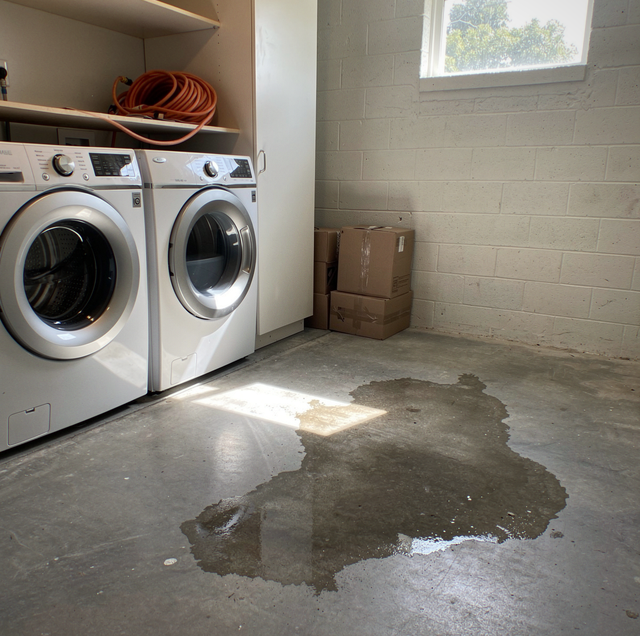
Water leaves a break sideways and lands going down. It runs along the top of a floor until it finds a seam, a register boot, a stair nose, or the gap under a door, and then it drops to the level below and spreads there beneath a floor covering where nothing shows for hours. The wet patch you can see is the smallest part of the picture at any given minute.
Direction matters more than volume for what you do next. If the break is on an upper floor, the room to look at is the one below it, rather than the one you are standing in. If it is low in the house or under a slab, the water has nowhere to fall and travels outward instead of down, under cabinets and into the bottom of walls, which is slower and much harder to see.
None of that changes the order. It changes where you put the towels and which rooms you walk, and it gives the plumber something worth hearing when you call. The order itself holds, whatever the shape of the house: people, then water, then pressure, then everything that can be undone later.
Contain What You Can, and Photograph It Before You Mop
Before one towel goes down, walk the wet area with your phone and take more photographs than you think you need. Get the standing water at its highest, the run of the wet edge across each room, the ceiling below it, and inside the cabinet under the sink. Photographs taken now cannot be taken later, and mopping destroys what they were of.
Then contain. Towels rolled at a doorway hold water out of a dry room better than towels spread flat in a wet one. Lift what lifts: get furniture legs up on blocks or foil, roll rugs back toward dry floor rather than dragging them through the wet, and move boxes off the floor of any room the water is heading toward.
Then stop. Do not open walls to find the pipe, do not pull up flooring, and do not run a household vacuum through standing water. Drying a structure and repairing a line are two different pieces of work, and both go better on a scene nobody has taken apart.
What the Plumber Needs to Hear When You Call
Lead with the things that change what goes on the truck. Say whether the main is closed. Say whether the water is hot or cold. Say where it is coming from, what sits below it, whether it still runs after the line drained, and whether anything electrical got wet. Those five answers let a dispatcher know whether you need a plumber this hour or an electrician first.
The order those first minutes belong in is the part worth holding on to, and it does not change with the size of the leak: people out of the water, water off at the main, pressure out of the line, hot side left alone, pictures before towels, then the call. You are not repairing anything in those minutes. You are keeping the list of what got wet short.
Frequently Asked Questions
No. The utility cuts service outside at the meter, and your whole house goes dark, refrigeration and heat with it. An electrician works at your panel and can kill only the circuits the water touched. Rooms it never reached are not the ones you want dark while you wait.
Steam, fogged glass, and warmth in the air the water point at the hot side. Once you have closed the main and the line has drained, a hot-side break keeps weeping longer, because the tank is still full and feeding it. If you are unsure, treat it as hot and keep your hands out.
Yes. Water stopping on its own means the line above the break has finished draining, not that the pipe has healed. The failure is still there, and your house is on a closed main, so you have no water until it is repaired. A pipe that let go once will let go again when you reopen that valve.
A repair clamp with a small pinhole can hold for a few hours, and it is worth trying if you already own one. Tape is not a repair on a pressurized line. Neither lets you reopen the main and walk away, and a patch left inside a wall is how the same leak returns in your drywall months later.
After, or at the same time if someone else in the house can make that call while you work. Stopping the water limits the loss, and it comes first. What a policy covers, and how quickly it asks you to report, are questions for your insurer and the policy wording, not for the plumber, so ask them directly and keep every photograph you took before the mopping started.
Three things, and all of them are quiet afternoon work. Learn where your main shut-off is, and close it and reopen it once a year so it still moves when it has to; a valve untouched for twenty years is the one that seizes shut. Put the plumber's number and your water utility's emergency number somewhere that is not only in one phone. And walk your house once looking for what sits directly under every bathroom, because that is the answer you will be asked for first, and it is far easier to find when the floor is dry.
Call for emergency pipe repair once the water is off — a licensed plumber finds the failed section, isolates the heater, proves the line holds pressure again, and says what has to dry before a wall closes. Jimmy Joe's Plumbing serves Mesa, Phoenix, and the Valley. ROC 273293. Call (480) 757-1273.