
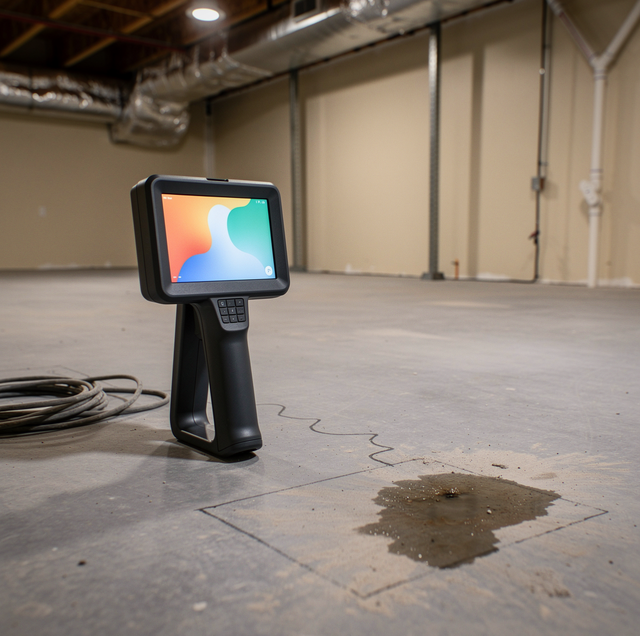
Quick Answer: Locating a hidden leak is a process of elimination: isolate the system and monitor pressure, map where the pipe runs, listen for the leak, then confirm the spot with a small opening.
A hidden leak always sits behind the one thing nobody wants to remove. Sometimes that is a poured slab; other times it is a closed wall cavity finished in tile that will not come up in one piece. That constraint shapes the entire job: the pipe cannot be inspected until it is exposed, and exposing the wrong stretch of it costs more than fixing the pipe does. So professional leak detection is not really a search for water. It is a sequence of indirect readings, each narrowing the possible area, until a single small opening can land on the pipe rather than near it. A meter check is the cheap first confirmation that water is leaving the system somewhere; what follows is what happens after it comes back positive.
Isolating the System and Watching Pressure Decay
A house's water supply is a closed system when nothing is running: shut the valve at the meter or the main, and the pipe downstream holds a fixed volume under pressure. If that pressure falls with every fixture off, water is leaving through something that is not a fixture, and a gauge on a hose bibb shows how fast.
The value here is not location but division. A technician closes valves to cut the system into pieces and repeats the test on each. Closing the cold inlet at the water heater splits the supply into hot and cold halves, and a loss that survives on only one side has eliminated half the pipe in the building. Angle stops, an irrigation manifold, a run out to a detached garage: each valve that closes is a section cleared or blamed.
In slab-on-grade construction, supply lines run beneath or inside the concrete with no crawlspace to walk, so valves are the only way to zone the house without touching the floor.
Do not try to pressure test a household line with a shop compressor. Water lines are rated for water pressure, not the higher, faster-releasing force of stored air, and an over-pressurized fitting can let go without warning.
Mapping Where the Pipe Runs
Before anyone listens, they need to know where to put the microphone, and plans are frequently wrong: remodels reroute lines, and a slab poured decades ago rarely matches paper. Line locating fixes that with a signal: a transmitter clips to an accessible point on a metal pipe and puts a current on it, and a receiver at the surface reads the field that current throws off, tracing the pipe's path and a rough depth.
Copper takes the signal directly. Plastic does not conduct, so a non-metallic line is traced another way: a small transmitting sonde is pushed through it, or a traceable rod fed in, and the receiver follows that. Either way, the output is a line drawn on the floor or wall in marker, with depth noted. Depth matters, because anyone planning a confirmation opening needs to know how much concrete and compacted fill sits above the pipe before a bit goes in.
Acoustic listening compares one point against neighboring points along a known path, so without that path the search is a grid of guesses.
Acoustic Listening and What Changes the Sound
Water escaping a pressurized pipe makes noise for a specific reason: the opening is small, the pressure difference across it is large, and the jet leaving it is turbulent, which vibrates the pipe wall and shakes whatever is packed around it. The sound travels up through soil and concrete as a faint signal, loudest directly over the escape point and weaker in both directions. A ground microphone makes that signal audible while the technician walks the marked line listening for the peak.
Two variables change what there is to hear. The first is pressure: a low-pressure line seeps rather than jets, and a seep is quiet, which is why a branch is sometimes brought back to working pressure to make it speak. The second is pipe material. Copper carries vibration efficiently along its own wall, so a copper leak is audible well away from the hole and the true peak has to be found by comparison, not presence. Plastic damps that vibration, so a PEX or PVC leak is quieter overall but is heard closer to where it really is.
Opening size cuts against intuition. A pinhole under full pressure screams, while a corroded split losing a large volume slowly can be nearly silent, because the water is pouring rather than jetting. A quiet line is not a dry line. A camera is the drain-side tool: it travels inside an open-to-air waste line, and nothing equivalent can be sent into a pressurized supply line, which is why the supply side is worked from the outside in.
Acoustic work needs a quiet house. Switching off the ice maker, the pool pump, the irrigation timer, and sometimes the air conditioning before the appointment removes the background noise that competes with the sound of water leaving the pipe.
Thermal Imaging and What It Detects
An infrared camera does not see water or see through concrete. It reads surface temperature and paints the differences in false color. That single mechanism explains both what thermal imaging is good at and how it gets misread.
A hot line leaking under a slab heats the concrete around it, and that heat spreads up to the floor as a soft oval, following the pipe rather than a tight dot, because heat moves in every direction as it rises. A cold-water leak is harder to detect: it can read as a cool zone where saturated ground pulls heat out of the slab, but only when the water is sufficiently colder than the floor to register.
The failure modes matter as much as the strengths. Sunlight through a window bakes a floor into a convincing plume, and ductwork above a ceiling does the same to drywall. Carpet and pad insulate so well that a real leak underneath produces almost nothing, while tile reads better but still smears the outline. Because the result is an area rather than a point, thermal imaging shrinks the acoustic walk from the whole room to a small part of it, rather than ending it.
Tracer Gas When a Leak Makes No Sound
Some leaks produce no usable noise no matter how the system is set up. Plastic pipe under a thick slab, a weep too small to count as flow, a line that cannot be pressurized without making the loss worse: all of these leave acoustic work with nothing to grab. Tracer gas stops depending on sound.
The line is drained and then charged with an inert blend, most commonly a small percentage of hydrogen in nitrogen. The mix matters mechanically, not chemically: hydrogen is the smallest molecule available, far less viscous than water, and it passes through an opening that water only seeps through. Inside the pipe, it finds the same defect the water found, escapes there, and rises through soil and the pore structure of concrete to the floor or grade. A sensitive detector is then walked along the marked line, and the strongest reading sits above the escape point.
This is technician work start to finish: the line is out of service while it holds gas, charging pressure has to be held against the pipe's rating, and readings mean nothing until the surface has had time to let the gas through.
Opening the Smallest Possible Access Point
Everything to this point produces a probability, not a fact. The pressure test indicates a branch is losing water; locating says the pipe runs here; the surface methods agree within a small radius. Only exposure turns that into certainty, and the goal is to keep it as small as the confidence allows.
One cheap check comes first. A moisture meter held against drywall or flooring indicates how much water the material holds, helping distinguish an old stain from a surface that is wet now.
In a wall, the result is a small rectangle of drywall opened between studs at the marked point, no larger than a hand and a light need. Under a slab, the result is a small area of flooring lifted and concrete removed directly over the pipe, after what sits inside the concrete has been scanned and marked. Both are licensed work with real consequences for getting it wrong: a plumbing wall cavity routinely carries branch wiring, a gas line, and the pressurized pipe itself, which is what a blind cut finds first.
What happens once the pipe is visible gets decided on different grounds: its age, its material, and how many more failures that line is likely to produce. None of it can be judged from the surface, which is why locating comes first.
Which Method Fits Which Failure
No single method answers the question alone, and the sequence is not arbitrary: each step either eliminates ground or hands the next a smaller area. Here is what each tool measures and where it goes blind.
| Method | What It Detects | Where It Fails |
|---|---|---|
| Pressure isolation test | Whether a closed section loses pressure, and how fast | Proves a section leaks, never where inside it |
| Line locating | The path and rough depth of the pipe, not the leak | Non-metallic pipe with no sonde access reads as nothing |
| Acoustic listening | Sound energy from water escaping under pressure | Low pressure, plastic pipe, or a large slow opening that barely sounds |
| Thermal imaging | Temperature difference at the surface above the pipe | Cold-side losses with no contrast; sun, ductwork, and carpet all mislead it |
| Tracer gas | Gas concentration at the surface above the escape point | Needs the line drained and out of service; sealed flooring traps and spreads the gas |
| Moisture meter | How much water a wall or floor covering holds right now | Confirms wetness at the surface without locating the pipe |
| Access opening | The pipe itself, and whether the mark was right | Costs finish material every time, so it goes last |
Three details drive the sequence. The first is which half of the system is losing water, because a hot-side loss invites thermal imaging, whereas a cold-side loss usually does not. The second is pipe material: copper carries sound and takes a locating signal directly, while PEX and PVC give up neither and push the work toward a sonde and gas. The third is what sits over the pipe: carpet blinds a thermal camera and muffles a microphone, sealed tile reflects sound but holds gas underneath, and bare concrete is the friendliest surface these tools meet.
Frequently Asked Questions
For the pressurized methods, yes. A gauge only falls, and a microphone only hears while the line is under pressure and losing water. Intermittent leaks are the awkward case: a joint that weeps only when a fixture runs passes a static test cleanly, so the condition has to be reproduced and watched.
The drain is plugged, and the pan is filled to just below the curb, and the water level is monitored over a set period. It tests the pan liner and drain assembly rather than the supply piping, and it is the usual next move when the supply side tests tight.
Post-tensioned slabs contain steel tendons under high tension inside the concrete. Cutting one is dangerous and expensive, so the tendon layout is scanned and marked before any opening is made. It also limits where an opening can go.
Mostly, with adjustments. Those lines are usually PVC, often shallow, and can be isolated one at a time at the equipment pad or valve manifold, which makes division faster than in a house.
Plan on a block of time, not a quick stop. Much of it is setup and elimination before any listening starts, and a line that has to be drained and charged with gas adds time on top of that. Stubborn jobs sometimes move to late evening, when street traffic and household equipment have gone quiet.
Because the rest of the line is the same age, the same material, and has seen the same water. A pinhole in aging copper usually means the pipe has reached a condition, not that one spot got unlucky, so a second whole-house pressure test after the repair is standard.
Pinpoint the leak before anything gets opened — a licensed technician isolates the system, locates the line, and marks the spot so the repair starts in the right place. Jimmy Joe's Plumbing serves Mesa, Phoenix, and the Valley. ROC 273293. Call (480) 757-1273.