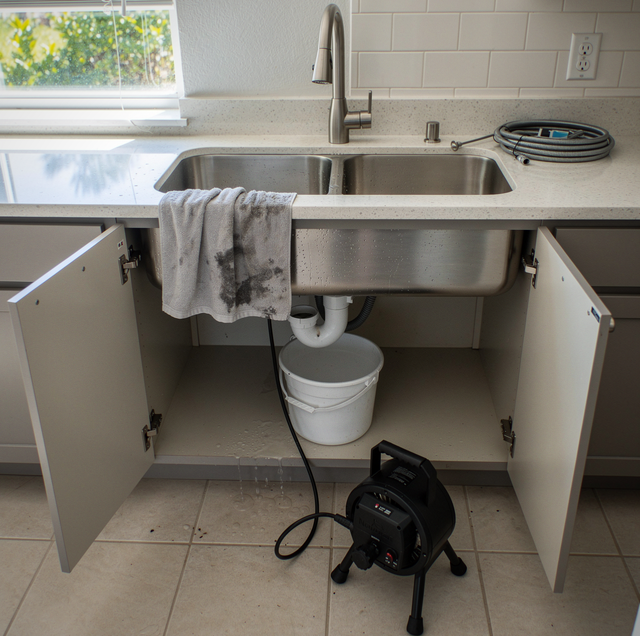
The kitchen sink is holding water, the plunger has done nothing, and the choice in front of you is between two machines: one that sends a spinning steel cable down the line, and one that sends water at high pressure.
They do different work, and which one clears your line for good follows from that. A cable clears the passage. Pressurized water clears the pipe wall. If what closed your line is a layer bonded to the pipe, water is what takes it off, and a cable bored through that layer leaves whatever it did not touch on the wall. If what closed it is a rag or a root mass, the cable is what removes it.
What your pipe can still take is the second half of the answer, and it can rule out the tool the blockage calls for. Both are visible on a camera before either machine runs.
What a Cable Does Inside the Pipe
A drain machine is a drum, a motor, and a length of spring steel. The drum turns, the cable inside it carries that rotation to a head at the working end, and the operator feeds it into the line by hand while it spins. The head is chosen before the machine goes on: a bulb or arrow head for soft plugs of hair and soap, a C-shaped cutter or a sawtooth blade for roots.
Cable diameter scales with the pipe. Five-sixteenths of an inch suits the trap arm behind your bathroom sink; three-quarter-inch cable goes into a four-inch building drain, and a drum machine carrying that size is rated for three- to six-inch lines. Feed a light cable into a big line, and it coils instead of cutting.
What you feel at the fixture is the appeal of the method: the head bores a passage through the obstruction, the standing water drops away, and your sink runs while the machine is still going. You are left with an opening roughly the diameter of the head through a mass that may fill the pipe, and everything the cutter passed by is still on the wall.
What Pressurized Water Does to the Pipe Wall
A jetter is a pump, a length of high-pressure hose, and a working end small enough to travel the line. Pressure, in pounds per square inch, breaks material off the surface it is stuck to; flow, in gallons per minute, then carries what the pressure freed out to the sewer. Flow acts only on what pressure has already released, so the two figures are read in that order. Jetters on the market run from about 1,750 psi and 1.4 gallons per minute up to 3,000 psi and 5.5 gallons per minute. The gap between those flow figures is the gap in how much material leaves your pipe.
A water stream loses energy fast as it spreads from the orifice, so the cutting happens where the stream meets the wall, which is why the hose is worked along the line rather than parked at the blockage. As it travels, the stream sweeps the full inside circumference, including the low side where grit settles. The finished surface is bare pipe.
Every gallon the pump sends up the line comes back down carrying debris, so the pipe below the working point has to be open enough to take it. A line blocked end to end gives the water nowhere to run, which is why a cable goes in there first, to open a path.
Which Tool Suits What Is Blocking the Line?
Grease is the case that makes jetting look like different work altogether. It enters the line hot and liquid, meets a pipe wall that is well below its own temperature, and sets as a layer inside the pipe. That layer is rough and tacky, so every solid passing afterward catches on it, and the line closes at the spot that closed last time. A cable bores straight through it, and your sink runs that afternoon. The layer stays.
Roots reverse the priority. A root mass enters through a joint or crack, thickens inside the pipe, and catches paper and solids in the mesh it forms. Severing a half-inch root is mechanical work, and a blade on a spinning cable is what shears the mass back to the wall. Water strips what is left clinging there and carries the fragments away. Neither one closes the crack the roots came through.
Then there is everything that is simply an object, a rag or a wipe in a kitchen line. Pressurized water can drive a rag further along and pack it tighter into a fitting, while a hooked retrieving head on a cable brings it back out through the cleanout whole. That is where a cable is the only tool that finishes the job.
| What is in the line | What a cable does | What a jet does |
|---|---|---|
| Grease and soap film | Bores a passage; the layer stays on the wall | Strips the layer back to bare pipe |
| Root intrusion | Shears the mass off at the wall | Flushes the fragments, leaves the entry point |
| A rag, wipe or dropped object | Hooks it and pulls it back out | Can pack it tighter downstream |
What the Pipe's Condition Rules Out
Both machines act on the pipe and on what is in it, so the condition of your line sets the limit. Cast iron corrodes from the inside out. The corrosion grows into hard nodules while the sound metal underneath thins, and a section that has thinned for decades can be a shell in places. Sound cast iron takes a jet stream at three thousand psi without complaint. A wall that corrosion has already opened is a different situation, and so is a thin section meeting a cutter head loaded with torque.
Clay behaves its own way. It holds up in compression and is brittle at the joints, where soil movement offsets it, and roots find their way in. Pressurized water passing an open joint enters the soil around the pipe rather than flowing down the line, and it carries fines out of the bedding the pipe sits on.
None of that is a judgment you can make standing at your own sink. It is why the inspection comes first, and why a technician will ask what has already gone down your drain before opening anything. Whether the blockage sits in your fixture branch or out in the main line is a separate diagnosis.
A blocked drain cannot carry chemical drain opener away, so it sits at full strength above the clog. Opening the line at a cleanout, or running a machine into it, puts that liquid onto whoever is working there.
What the Camera Shows Before and After
A drain camera is a waterproof head on a push rod, fed through a cleanout, and it earns its keep by going down the line twice. The first pass covers what the obstruction is made of, how far along it sits, and whether the wall behind it is sound enough for the method being considered. Grease appears as a pale, smooth coating narrowing the bore evenly, and a belly, a section of pipe that has settled low, appears as standing water that will not drain with every fixture upstream shut off.
The second pass is the easy one to skip, and it is the one that answers the question you started with. After a cable, the camera shows a passage bored through material still sitting in your pipe. After jetting, it shows the wall, and what is on that wall is the part worth your attention: the hairline crack the grease was sitting in, or the offset joint underneath it. Those findings only exist once the pipe is clean enough to see them.
Frequently Asked Questions
You can rent one, and whether you should depends on what the machine asks of you: the cable spins under power while your hand guides it into the line. The manufacturer's operator manual for drum machines calls for a drain-cleaning glove made for that job and says never to use rags, cloth gloves or loose-fitting gloves: the rotating cable catches them and winds them around your hand, breaking fingers and wrists. Keep the span between the drum and the pipe short so the cable cannot loop, and stop the drum before repositioning anything.
Drain, waste and vent plastic is not sold with a pressure rating: a national standard covers solvent-cemented PVC pipe and fittings for non-pressure drainage, with a matching standard covering ABS. So the number to weigh is not the pipe's burst strength but the state of its joints and any crack in the wall. Sound plastic of either kind takes jetting without trouble, and a poorly cemented joint is where water finds its way out of your line.
It needs continuous water, more of it than the pressure figure suggests. The pump has to stay flooded to survive, so the operator feeds it from a buffer tank filled off a hose bibb rather than running the machine straight from the hose. Losing supply even briefly can damage the pump, which is why a spigot at your house that barely trickles is worth mentioning when you book the work.
They act on organic material only. The bacteria in them digest fats and the film food waste leaves behind, and the label directions call for the product to go in when you will not be running water for several hours, because contact time is what the reaction needs. That makes them a maintenance measure for a line you have already had cleaned, and useless against roots or mineral scale.
Neither of these tools on its own. Corrosion in cast iron grows as bonded nodules called tubercles, and the tool for those is a descaler: a flexible shaft carrying free-swinging chain ends that spin inside the pipe and knock the nodules off the wall. A jetter then flushes the loosened debris out. Hard water compounds it, since scale from dissolved minerals deposits on the roughened surface the corrosion has left in your pipe.
The working end carries small orifices angled backward and one aimed forward. The rearward jets produce thrust that pulls the hose up the line against the returning water, while the forward jet opens a path through whatever is plugging the pipe. The head is chosen for what is in your line: a penetrating head for a solid plug and a spinning head for a coating gone hard.
Have a stubborn clog looked at before it gets cleared — the plumber matches the tool to the pipe and to what is actually in it. Jimmy Joe's Plumbing serves Mesa, Phoenix, and the Valley. ROC 273293. Call (480) 757-1273.