
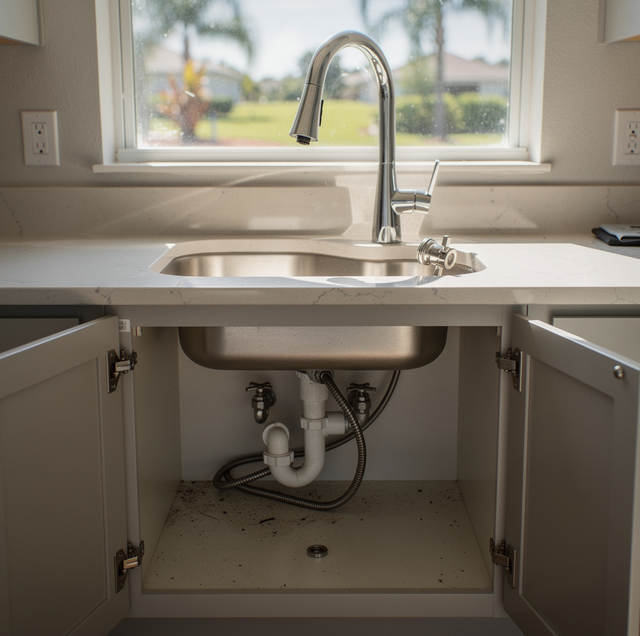
When one faucet runs weak while every other tap in the house fills a glass or a pot at full strength, the water supply coming into the house is not the problem. Something specific to that one fixture's own path is choking flow between the spout and the point where its line splits off from the rest of the plumbing. That path runs through a short, fixed sequence of parts: the aerator on the spout, the cartridge or valve inside the faucet body, the supply stop under the sink, and the flexible line connecting the stop to the faucet. A restriction anywhere in that sequence shows up as weak flow at that one fixture and nowhere else, and working back through the sequence in order finds the choke point without swapping parts at random.
Matching what the faucet is doing against where each part sits in that sequence narrows the search before any tool comes out:
| What you notice | Likely location |
|---|---|
| Stream thin or the spray fanned oddly, only from that spout | Aerator |
| Weak no matter what happens to the aerator, tied to one handle | Cartridge or valve |
| Flow improves right after the stop is opened fully, or has faded over months | Supply stop |
| Flow drops when the line under the sink gets bent, or changes from one day to the next | Supply line |
| Hot weak, cold fine at the same faucet | Hot-side path only |
| Still weak after checking all four, or a nearby fixture on the same wall is soft too | Past the fixture |
The Aerator
The aerator is the small screen threaded onto the end of the spout, and because it is the last part the water passes through, a restriction there affects only that one faucet and never the fixture next to it. Inside sit a fine mesh screen and a shaped flow-limiting disc that set the fixture's normal output. Grit carried over from a repair elsewhere in the line, a shred of loose gasket material, or mineral flake caught across the mesh narrows the opening without sealing it, so the stream goes thin, or the spray pattern turns into an uneven fan instead of stopping outright.
Shut the stops under the sink before removing the aerator, so a handle bumped open mid-job cannot send water through the open spout. Unscrew it by hand; an aerator seized by mineral buildup is part of the repair visit. Then soak the screen and disc in a mineral-dissolving solution and rinse them clean.
Lay a towel over the drain opening before unscrewing the aerator. The screen, washer, and flow-limiting disc are small enough to drop into the drain, and a lost disc can change the faucet's flow once the faucet is put back together.
If flow returns to full strength once the aerator is clean and back in place, that was the whole cause. If the spout remains weak even after the aerator is removed entirely, the restriction is farther back in the sequence, starting with the faucet body.
The Cartridge or Valve
Inside the faucet body sits the part that opens and closes the water path: a single cartridge on a one-handle faucet, blending hot and cold in one piece, or two separate stems on a two-handle faucet, one for each side. A seal or O-ring inside that part can swell, wear unevenly, or collect scale along its ports, and a worn seal does not always announce itself as a drip. It can instead narrow the passage through the cartridge or stem and quietly cut the flow reaching the spout, with no leak at all to point to the problem.
Testing this means shutting both stops under the sink, pulling the cartridge or stem for that faucet's design, and inspecting the ports and seals for scale or trapped grit before cleaning or replacing the part. On a two-handle faucet, because each handle runs its own separate stem, weak flow tied to a single handle position narrows the search to that one stem rather than the whole faucet body; a one-handle faucet blends both supplies in a single cartridge, so a problem there can affect the mixed output no matter which way the handle turns.
The Supply Stop Under the Sink
Below the faucet, a supply stop (an angle valve, either a quarter-turn ball type or an older multi-turn compression type) connects the flexible line to the fixed plumbing feeding the house. A stop left partway closed after earlier work under that sink is worth ruling out first: turning it the rest of the way open, if the handle turns freely, takes a moment and costs nothing to check before looking at anything else. Past that simple check, the valve is meant to open fully when its handle is turned all the way, but a stop that sits untouched for years can accumulate mineral deposits on its seat or inside its body, narrowing the passage even when the handle is turned as far as it goes. A stop that is opened and closed from time to time can stay clearer than one that nobody has touched since the house was built, which is why an older, never-serviced stop is worth checking directly rather than assuming it is fine.
A supply stop left untouched for years can shear at the stem when forced, and a sheared stop leaves no way to shut off water before it floods the cabinet. A plumber replaces a frozen stop under controlled conditions.
Because forcing a seized stop risks breaking it, confirming this cause safely means having the stop's condition checked and, if it has failed, replaced rather than worked past.
The Supply Line
The flexible line running from the stop to the faucet's tailpiece is narrower in diameter than the fixed pipe feeding it, so a partial obstruction in that short run restricts flow more proportionally than the same amount of debris would in the wider pipe upstream. A line kinked or pinched by bottles and cleaning supplies stored in the cabinet narrows its own bore at the bend. The rubber liner inside an older braided line can also trap scale or begin to delaminate on the inside, narrowing its own bore from within even though the outside of the line looks fine.
Swapping the line for a new one, or simply straightening it if it has been bent under stored items, tests this stage directly: if flow returns once the line runs clear and unobstructed, the line itself was the limiting point.
Hot Side Only or Both Sides
Whether the weak flow is on the hot side alone, the cold side alone, or both at once narrows the search a step further, because hot and cold travel through separate halves of the sequence up to the point where a single-handle faucet blends them, or all the way to the spout on a two-handle faucet. Weak flow on the hot side with the cold at full strength points to something on that side's own path: its half of the cartridge or valve, its own supply stop, its own flex line, or the hot supply upstream of the stop. Weak flow on both sides at the same faucet, once the aerator has already been ruled out, points to a shared point further along, the cartridge on a one-handle faucet or the spout passage where both supplies meet, or to the same fault repeated on both sides.
When One Fixture Points Past the Fixture
After the aerator, the cartridge or valve, the supply stop, and the supply line have all been checked. None of them explains the weak flow, or a fixture nearby on the same wall or the same branch is showing the same faint weakness, the restriction has moved past the fixture and into the branch line behind the wall. That is a different repair than anything under the sink, since it means opening a wall or floor rather than swapping a part at the faucet. If every fixture in the house is weak rather than just one branch, that points to a whole-house pressure issue rather than a single fixture's supply path.
Frequently Asked Questions
Can reassembling the aerator wrong cause weak flow on its own?
Yes. The flow-limiting disc and the washer behind the mesh screen stack in a specific order, and swapping their positions after cleaning can still throttle flow, even when every piece is clean and free of mineral buildup. It is worth checking before assuming the parts need replacing rather than reseating.
Does a ball-type single-handle faucet show weak flow differently than a cartridge type?
It can. A ball-type valve rotates a slotted ball across the hot and cold ports as the handle moves, so flow can drop at one end of the handle's travel and pick back up toward the other end; a worn cartridge restricts flow through its ports instead, which does not follow the handle position.
Will letting the faucet run for several minutes clear a restriction sitting inside the supply stop?
No. A supply stop is a manual valve, not a filter the flow passes through and rinses clean. Mineral deposits that build up on its seat or inside its body stay put regardless of how long the faucet is left open; clearing them means servicing or replacing the stop, which, on an old valve, is plumber work.
Does replacing the whole faucet fix weak flow if the cartridge was not the cause?
Not on its own. A new faucet still draws from the same supply stop, and one hooked to the old flexible lines keeps those as well, so if the restriction sits upstream of the faucet body, the new unit shows the same weak flow as on its first day in service.
Can a restriction in the supply line make flow come and go instead of staying weak all the time?
Yes. A flake of scale or a section of a delaminating liner inside a flexible line can shift position with water pressure, opening up for a run or two before settling back across the opening, which reads as inconsistent flow rather than a steady, unchanging weak stream.
Can weak flow on just the hot side trace back to the water heater rather than the faucet?
Yes. Sediment that has broken loose from the bottom of a tank can travel through the hot line during a period of heavy use and lodge at the narrowest point downstream, which can be the faucet's own hot-side parts, so a sudden hot-only weak flow following a stretch of heavy hot-water use can start at the heater rather than at the fixture.
Bring in a faucet repair — the aerator, cartridge, supply stop, and supply line are checked in order, and the part choking the flow is cleaned or replaced. Jimmy Joe's Plumbing serves Mesa, Phoenix, and the Valley. ROC 273293. Call (480) 757-1273.