
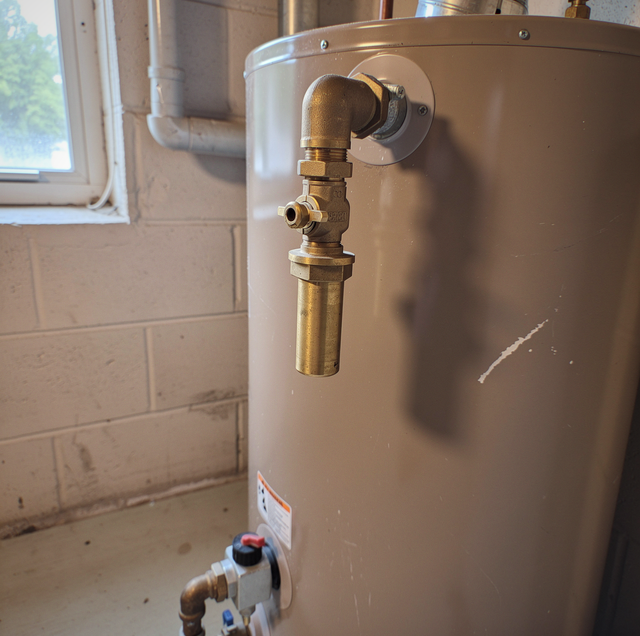
The short-capped pipe hanging below the gas line just before a water heater, furnace, or other gas appliance is a sediment trap, also called a drip leg. It sits under a tee in the supply, between the shutoff valve and the appliance, and it has one job: to give scale, rust flakes, and loose bits of pipe joint compound somewhere to drop before they reach the appliance's gas valve and burner. It has nothing to do with the mineral sediment that settles inside a water heater tank, which comes out of the water; the debris in this trap rides in with the gas, and the two never meet.
Because the part is small and unlabeled, it gets mistaken for a leftover stub, a drain, or a place to bleed air. It is none of those, and the cap on the end is holding back gas at line pressure. If you ever smell gas near an appliance, leave the house and call from outside before anything else. Each arrangement you might find at the connection is paired here with what it means and who deals with it:
| What you see at the appliance | What it means | Who deals with it |
|---|---|---|
| A vertical capped pipe hanging below a tee | A sediment trap in its working position | Nobody, until the appliance is replaced or moved |
| No trap, with the connector running straight into the appliance valve | Loose debris has a clear path to the valve inlet | A licensed plumber; whether a trap is needed is the local inspector's call |
| A capped stub that runs sideways off the tee | A dead end with no drop, so debris carries past it | A licensed plumber, at the next replacement or move |
| A flexible connector passing through a wall, floor or cabinet side | The connector is hidden where an edge can wear on it unseen | A licensed plumber reroutes the connection |
| A connector reused from an old appliance | A part bent to fit one installation, bent again for a second | A licensed plumber fits a new one |
How a Sediment Trap Works at the Tee
The trap is three pieces: a tee, a short length of pipe threaded into its bottom outlet, and a cap. Gas arrives at the top of the tee, and the appliance takes its supply from the side outlet. Gas under pressure makes the turn toward the appliance without effort. A flake of rust or a grain of scale has its own weight, and at the tee, a heavier flake can keep falling into the leg below instead of making the turn.
That leg is a dead end. Nothing flows through it, so the gas inside sits still, and anything that drops in stays at the bottom against the cap. The whole arrangement depends on gravity, which is why the leg hangs straight down. Turn the same fitting on its side and the dead end has no drop: debris rolls along the bottom of the pipe and follows the gas around the corner, so a sideways stub traps little.
Position along the line matters as well. A trap placed well upstream, with a long run of pipe between it and the appliance, leaves that run free to shed its own rust into the gas after the trap has done its work. The trap earns its place close to the appliance inlet, after the shutoff valve, where there is little pipe left for debris to collect.
Where the Debris in a Gas Line Comes From
Steel gas pipe leaves the mill with a thin layer of scale on its inside wall, and over years some of that scale loosens. Rust can form wherever moisture got into the pipe before the system was sealed, and it flakes away on its own schedule. Every threaded joint carries a sealing compound, and a joint made with a heavy hand can push a bead of it into the bore, where it hardens and breaks off. Cutting and threading pipe leave metal shavings, and dirt can get into the open end of a pipe during construction.
In a quiet system, this material sits still. It moves when something disturbs the line: a new branch cut in for another appliance, a section of pipe replaced, or work at the meter. Any of those can send loosened material downstream the next time an appliance calls for gas, and the trap is the last place in the piping where it can stop.
What Debris Does at a Pilot or Burner
A pilot burns through an opening small enough that a little debris can partly block it. A partial blockage can leave a short or bent pilot flame that no longer heats its sensor, and the gas valve shuts off as it is built to, so the pilot keeps dropping out. At a main burner, debris lodged in an orifice can cause one port or burner to produce a weak, uneven flame while the others burn with a steady flame. A particle caught on the seat inside the gas valve can keep the valve from closing fully, and on some gas valves a fine inlet screen catches debris first and then restricts flow as it loads up.
None of these symptoms belongs to debris alone. A weak flame, a pilot that will not stay lit, or burners that light unevenly can also stem from gas pressure, a failing sensor, or a control fault, and a technician will determine which before replacing anything. A carbon monoxide alarm going off is a different situation entirely: everyone gets out of the house, and the appliance stays off until it has been checked.
Loosening the cap even a quarter turn releases gas at line pressure beside a pilot or igniter, a fire and explosion hazard to anyone in the room; opening a trap is work for a licensed plumber with the supply shut off.
Where the Trap Sits on a Water Heater, a Furnace and Other Appliances
On a tank water heater, the gas line drops down beside the tank toward the control valve on the front. The shutoff valve sits on that drop, and the tee and trap sit below it, with the connection turning into the control valve. The trap is the lowest point of the gas piping at the heater, and it can sit close to the floor.
On a furnace fed from the side, the shutoff and tee can sit outside the cabinet, the trap hangs below the tee, and the pipe from the side outlet enters the cabinet to reach the gas valve inside. On some furnaces, the trap is out of sight behind a panel or against the wall, so its absence can go unnoticed.
On some appliances, such as a range or a dryer, no trap is fitted, and the flexible connector runs from the shutoff to the appliance. Whether a trap is needed for a given installation is for the local inspector to decide, and the answer can vary by appliance and jurisdiction. The same holds for gas fireplaces, pool heaters, and other equipment: the part and its position are the same wherever one is fitted, a tee with a capped leg below it, just before the appliance inlet.
Checks When an Appliance Is Replaced or Moved
A replacement or a move is the point at which the whole connection is reviewed again, because the old arrangement was fitted to a different appliance in a different spot. The trap, the shutoff, and the connector each get attention.
The trap: Is there one? Does it hang straight down below a tee? Is it between the shutoff and the appliance inlet, and is it capped tight? A sideways stub or a trap placed far upstream is corrected while the line is open anyway.
The shutoff: A manual valve belongs within reach of the appliance, ahead of the connector, where it can be turned without moving anything. A valve that is seized, buried behind the appliance, or missing is replaced or added.
The connector: A new appliance gets a new connector, sized for its gas demand and long enough to reach without strain or kinks, running in the open between the shutoff and the appliance. A connector passing through a wall, floor, or cabinet side is rerouted so the rigid pipe makes that passage instead.
After reconnection, every joint that was opened is checked for leaks using a gas-detection method, and the appliance is lit and its flame checked before the work is done. A flame is never a way to look for a leak at any gas fitting. Moving or reconnecting a gas appliance is a licensed plumber's job, and any permit for the work is issued by your local authority.
Why the Cap Stays On
The cap is the only thing closing the bottom of the leg, and behind it is the full gas supply to that appliance. It is not a cleanout intended for routine use, and it does not need to be emptied on any schedule. Tapping the leg, turning the cap to see whether it moves, or putting a wrench on the fittings above it can disturb the threaded joints, and a joint that was tight for years can start to leak from a little torque in the wrong direction.
When a trap needs attention, the trigger is a flame or valve problem at the appliance, or an appliance being replaced. Opening it is gas work: the supply is shut, the cap comes off, the leg is cleared, and the joint is remade with the right sealant and proven tight before the appliance runs again.
Frequently Asked Questions
Is a drip leg the same thing as a sediment trap?
The names get used for the same fitting at an appliance. Strictly speaking, a drip leg was built to collect liquid that condensed from gas, and it could be located at a low point in the piping, well away from any appliance. A sediment trap is installed at the appliance inlet to catch solids.
What is the fitting with a large nut near the trap?
That is a union. It lets the piping be separated at that point without turning the pipe on either side, which is how an appliance comes out for replacement. It is also a joint that seals under that nut, so it stays untouched unless the gas is off and a plumber is working.
Does a tankless water heater have a sediment trap?
It can. On a wall-hung tankless unit, the gas inlet can sit on the underside of the cabinet, so the tee and its capped leg hang below the unit rather than beside it. Its fine burner openings make clean gas just as important there as on a tank heater.
Can a sediment trap be added to an existing appliance?
Yes. The tee and leg go in between the shutoff and the appliance inlet, with the gas off. Fitting them takes up space in that short run, so adding one can change the length or route the connector needs, and the connector may be replaced at the same time.
Does a trap on a propane system work the same way?
It works the same way, and propane can carry an extra kind of debris. Some propane supplies leave an oily residue, sometimes called heavy ends, that can settle in regulators and low points. A trap at the appliance catches some of that along with scale and rust.
How much debris is normal to find in a trap?
On a clean system, very little: a trace of fine rust or a few flakes of dried compound. A trap packed with material, or one holding liquid, can mean something upstream is shedding or letting moisture in, and that is a reason to have the gas piping itself looked at.
Hire gas line and appliance connection service — the work covers the sediment trap, the shutoff valve, and the connector at each gas appliance. Jimmy Joe's Plumbing serves Mesa, Phoenix, and the Valley. ROC 273293. Call (480) 757-1273.