
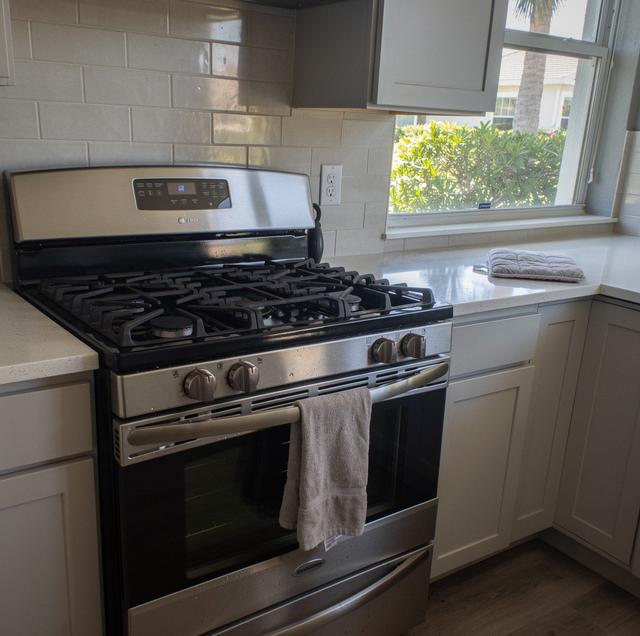
The oven door is open, and you are reaching for a pan when the smell arrives. Sharp, sulfurous, sitting in the air of the kitchen rather than rising out of the sink. It was not there twenty minutes ago.
If you can smell that in the room right now, stop reading and do this in order. Do not operate anything electrical. No light switches, no thermostat, no garage door opener, no doorbell. Do not use a phone while you are inside the building. Any one of those can make a spark. Do not light anything, and do not try to find the leak. Get everyone out, pets included, and leave the door open behind you if you can do it without delay.
From outside, well away from the building, call 911 or the gas utility's emergency number. A gas odor is an emergency call, not a service request. If you already know where the meter's service valve is and you can reach it from outside, you can shut it, but do not go back in for it, and do not go back in for anything else. Nobody re-enters until the fire department or the utility says the building is clear, and relighting a pilot afterward is the fire department's or a licensed technician's work, not the homeowner's.
That sequence runs the same way whether the smell turns out to be fuel gas or not, because being wrong is only expensive in one direction. Four things in an ordinary house smell like rotten eggs, and only one empties the building. One is barely in the room air at all: a sulfur smell that shows up only in running hot water is water arriving at a tap, and this page is about air in a room.
Why Distance Comes Before Diagnosis
Natural gas burns in air only within a band of roughly 5 to 15 percent by volume. Propane's band is lower and narrower, about 2 to 9.5 percent. Below that band, a room can smell strongly and still not ignite; inside it, almost nothing is needed. The minimum ignition energy for methane in air is a fraction of a millijoule, well under the arc inside a wall switch, a thermostat relay, or the static charge you build walking across carpet. There is no way to look at a device and know which one arcs.
Fuel gas is also a simple asphyxiant. It does not poison you; it displaces the oxygen in a closed room: headache, dizziness, and nausea, with judgment among the first to go. Finding which joint is leaking is done with a meter in a ventilated space, and both halves of that are past what a homeowner should be doing.
Natural Gas or Propane: The One That Empties the Building
Both fuels come out of the ground odorless. The smell is added: mercaptan, a sulfur compound blended in at a concentration intended to be obvious, roughly a fifth of the level at which the mixture could burn.
It is strongest at the appliance or the pipe: the connector behind the range, the union above the water heater, the valve on the wall. And it does not need anything switched on. Gas escapes at line pressure whether the burner has fired today or not, so unlike a tap-side or drain-side smell, it will not come and go with what you use. Onset separates it from the one other smell that also ignores your switches: gas arrives in minutes, decomposition takes days.
Where you notice it depends on the fuel. Methane is a little more than half the density of air, so natural gas rises, gathers along the ceiling, and travels there into the next room. Propane is about one and a half times the density of air, so it sinks and pools in the lowest space it can find. A propane leak can read as nearly clean at nose height while the floor of that room is loaded.
A carbon monoxide alarm does not detect natural gas or propane. It responds to a byproduct of burning, not to raw fuel, so a silent CO alarm is no evidence that the air in a room is clear.
A Water Heater's Anode Rod Reaction: Hot Water Only, at the Tap
This is the most common false alarm, and there is real chemistry behind it. Sulfate-reducing bacteria in the tank convert sulfate in the water into hydrogen sulfide, using hydrogen given off by the magnesium anode rod as it corrodes, which is what that rod is installed to do. Hydrogen sulfide smells like rotten eggs far below any concentration that is hazardous in a household tank.
The sigs are consistent. It shows up on the hot side and not the cold. It arrives at the fixture, out of the running water rather than in the air of the room, and fades within a minute of the tap closing. It is worse after the water has sat still, which is why the first shower after a weekend away is the classic case. A softened supply speeds anode consumption. And none of it depends on whether the burner is running.
This is a plumbing call rather than an emergency, and it is still worth confirming, because "it's just the anode" is a conclusion drawn partly from what you did not smell. Whether magnesium, aluminum-zinc, or a powered rod belongs in a given tank is part of that repair.
A Dry P-Trap or Sewer Gas: Strongest at a Drain, Swinging With the Stack
Every fixture drain holds a water seal in the U of its trap, the only thing between the room and the drain line. In a guest bath nobody uses or a laundry floor drain, the water evaporates, the seal breaks, and the drain becomes an open pipe. What comes back up is hydrogen sulfide again, along with methane and ammonia, generated on the sewer side rather than inside a tank.
It reads differently from mercaptan in two ways. It is strongest with your head near the drain opening and thin three feet away, and it is present with every tap off, but its strength swings as another fixture drains and shifts pressure in the stack. Once fuel gas is ruled out, running water into the fixture for a minute refills the trap, and that's a homeowner's job. If it returns within days on a drain that gets regular use, the trap is not what failed. A wax ring under a toilet, a cracked vent in a wall, or a dead trap primer will all reproduce it.
A Dead Animal in a Wall or Duct: Days to Build, Nothing Switches It Off
Decomposition puts out a mix that includes sulfur compounds, so the first day or two can read as rotten eggs before it turns heavier and sweeter. The shape across time is the giveaway: it builds over several days, holds about a week, then fades over the two or three after. Warmth speeds the curve and cold stretches it out, so the same animal in the same wall reads differently in different months.
Nothing you operate changes it: no tap, no appliance, no switch. It stays put in one wall bay or stretch of ceiling, or it strengthens at a return air grille when the blower runs, which places it in the duct rather than the framing.
Your Nose Is Not a Detector
Three things make smell an unreliable instrument here, and none are about paying closer attention. Sensitivity to mercaptan varies from person to person and declines with age, congestion, smoking, and certain medications, so one person can find it obvious while another cannot pick it up at all. Receptors also adapt within minutes of steady exposure, so a smell that seems to have gone away tells you about your nose, not about the air. And gas that travels through soil before entering a structure loses much of its odorant to it, so a leak in a buried line can arrive almost scentless.
One sign bypasses the nose. A leak big enough to hear makes a steady hiss or whistle at a connector, a valve, or the meter, and in a quiet room it carries several feet. A hiss means a larger opening than a faint odor suggests, and it changes nothing about the response: everyone out, then call from outside.
A combustible gas alarm does the one thing your nose cannot: it does not adapt.
Mount a combustible gas alarm for the fuel you actually burn, and mount it for that fuel's density: within a foot of the ceiling for natural gas, roughly six inches off the floor for propane.
What Actually Leaks at a Gas Appliance
Five failures account for most appliance-side leaks, and none is something a homeowner should be hunting for.
The first is a threaded joint that has lost its seal. Gas piping is joined with tapered threads and a sealant rated for fuel gas, and vibration from a blower or compressor works at that joint for years. A union or flare fitting a quarter turn out of position leaks at a rate you can smell long before it does anything else.
The second is the flexible connector between the pipe and the appliance. An old uncoated brass connector is a known failure item: that alloy loses zinc across decades, and the flare end cracks where it is stressed rather than in the tube where a person would look. Coated stainless replaced them, and an uncoated one still behind a range or a dryer is a failure waiting for a date.
Third is the shutoff valve on the wall, which usually weeps at the packing around the stem rather than the seat. It leaks with the handle in either position, so turning it off proves nothing.
Fourth is work done nearby. A dishwasher install, a water heater swap, or pulling a range out to clean behind it can load a line that hasn't moved in years, and the smell often shows up days later.
Fifth is sealant gone brittle, or the wrong material on the threads. Ordinary thread tape is not rated for fuel gas, and a joint made with it can hold for years and then let go.
None of the five is homeowner work, and the reason is not paperwork. Pressure testing a system, reading a room with a meter, and proving a joint takes equipment and a procedure, and which license, permit, or inspection applies is a question for the local authority. The person who repairs it should be the one who can demonstrate it is repaired.
Frequently Asked Questions
Sometimes, though outdoors the visible signs beat the odor, because open air dilutes mercaptan quickly. Yellowed or dead grass or shrubs in a stripe over a buried service line, and bubbling in a puddle after rain, both point to gas escaping into the soil. Report either one from a distance.
Odor calls are dispatched ahead of ordinary service work, at any hour. Their job is to make it safe, not to repair it: they meter the building, find whether the leak is on their side of the meter or yours, and if it is yours, they shut the gas off and lock or tag the meter until the repair is made. Everything past the meter is your plumber's work.
That pattern points at the appliance's own gas train rather than the piping in the wall. The valve inside the appliance holds pressure off the burner manifold until it opens, so a leak downstream of it, at the manifold or a burner orifice, only sees pressure while the appliance is calling for heat. It still gets the same response.
Not reliably, because the smell in a room is an average and a leak is a point. Gas escaping into a closed water heater closet can reach a much higher concentration in that enclosure than in the room, and opening the door mixes the two. Faintness tells you about your distance from the source, not the size of the leak.
No, and on most current appliances there is nothing to light: they use electronic ignition or an intermittent pilot that fires on demand. On an older standing-pilot appliance, relighting is done with the thermocouple checked, and the burner flame confirmed as a stable blue, and the utility technician or your plumber handles it as the system comes back up.
Mercaptan absorbs into porous material. Drywall, carpet, upholstery, and clothing near the leak hold it and release it for a day or two after the gas itself is gone. Ventilate and watch whether it fades. If it holds steady or strengthens, treat it as a second leak, not rare when every connector in the house is the same age.
Have your gas lines and appliance connections tested by a licensed technician — a pressure test and a joint-by-joint inspection settle whether the smell was fuel gas or something harmless. Jimmy Joe's Plumbing serves Mesa, Phoenix, and the Valley. ROC 273293. Call (480) 757-1273.